
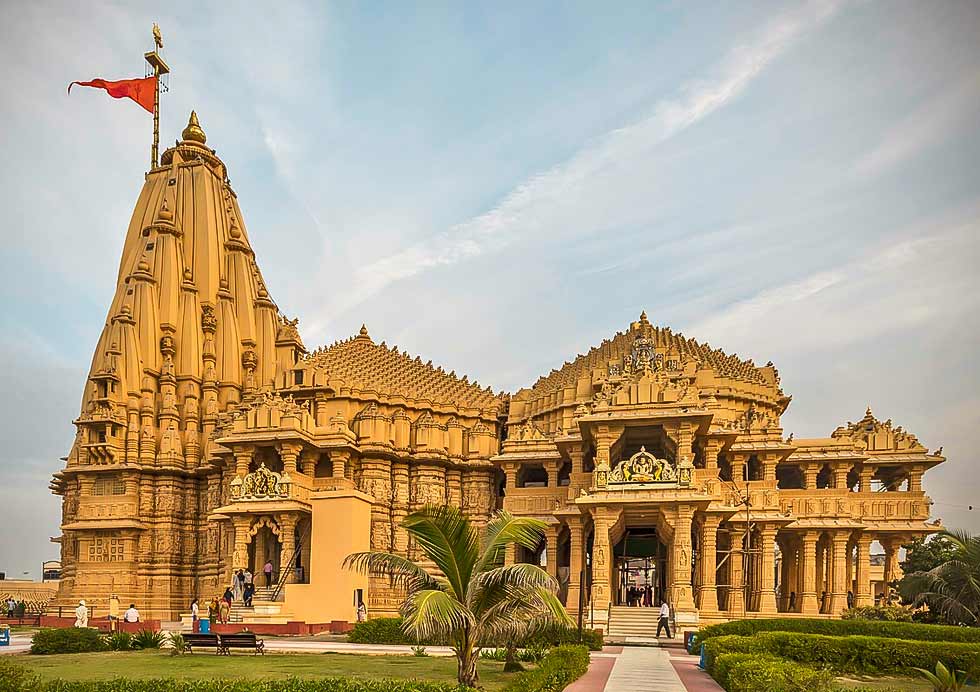
Somnath Temple
Context
PM Narendra Modi to visit Somnath Temple on January 11, 2026.
Visit marks 1,000 years since the first attack on Somnath (1026 CE).
Year-long commemorative programme announced: Somnath Swabhiman Parv.
Historical background
Mahmud of Ghazni’s attack
The first major attack occurred in January 1026 CE by Mahmud of Ghazni.
The temple faced multiple subsequent attacks, destruction, and rebuilding over centuries.
Somnath is often cited as a symbol of cultural continuity and civilisational resilience.
Post-Independence reconstruction
After 1947, the responsibility of rebuilding Somnath was taken up by Sardar Vallabhbhai Patel.
The restored temple was inaugurated on May 11, 1951.
2026 also marks 75 years of the reopening of the reconstructed Somnath Temple.
Somnath Temple:
Located at Prabhas Patan, near Veraval, Gujarat
One of the most sacred Tirtha Kshetra for Hindus
First among the twelve Jyotirlinga shrines of Shiva
Antiquity and early references
Exact date of the first temple construction is uncertain
Estimates range from early 1st millennium CE to 9th century CE
Ancient texts referring to the site:
Mahabharata
Bhagavata Purana
These texts mention Prabhas Patan as a pilgrimage site on the Saurashtra coast
Archaeological evidence:
No confirmed remains of an early temple
Evidence of settlement, not temple structure
Medieval destruction and reconstruction
Temple underwent multiple cycles of destruction and rebuilding
First well-documented major attack:
January 1026 CE
By Mahmud of Ghazni
Subsequent attacks by several Muslim invaders and rulers
Over centuries, Somnath became a symbol of contested sacred space k
Colonial-era interpretation and the “Gates of Somnath” episode
Lord Ellenborough and imperial symbolism
Lord Ellenborough served as Governor General (1842–1844).
Presented Somnath as a symbol of Islamic excesses against Hindus, fitting colonial “divide and rule” narratives.
Context:
British defeat in Afghanistan (1842).
Heavy military losses prompted a symbolic retaliatory act.
The Gates of Somnath controversy
British brought a pair of sandalwood gates from Ghazni to India.
Claimed (without archaeological proof) that:
These were the original gates of Somnath, taken by Mahmud of Ghazni in 1026 CE.
Lord Ellenborough proclaimed this as:
Avenging an insult inflicted upon Hindus 800 years earlier.
Modern historians view this as:
Political symbolism rather than historical restitution.
Junagadh accession and post-Independence reconstruction
Junagadh crisis
Somnath was located in the Junagadh princely state.
The Nawab of Junagadh acceded to Pakistan in August 1947.
Following rebellion, the Nawab fled.
India later integrated Junagadh through a plebiscite.
Sardar Patel’s role
Sardar Vallabhbhai Patel, then Home Minister:
Visited Junagadh (Saurashtra region).
Announced reconstruction of Somnath Temple.
Gandhian approach and temple trust
On Mahatma Gandhi’s suggestion:
Reconstruction funded by public contributions, not the state.
Trust established under:
K. M. Munshi
Reflected:
Commitment to secular state neutrality.
The present temple is a Māru-Gurjara architecture (also called Chaulukya or Solanki style) temple.
Somnath Temple is not directly mentioned by name in ancient Sanskrit texts of Hinduism. Instead, the texts refer to Prabhasa / Prabhasa-Pattana as a Tirtha (pilgrimage site). During the reign of Bhima I, the Ghaznavid ruler Mahmud invaded the kingdom and raided the Somnath temple during 1025–1026 CE. | ||
Prelims practice MCQs
Q. With reference to the Somnath Temple, consider the following statements:
The first recorded attack on the Somnath Temple took place in 1026 CE.
The reconstruction of the temple after Independence was led by Jawaharlal Nehru.
The restored Somnath Temple was inaugurated in 1951.
Which of the statements given above is/are correct?
(a) 1 and 2 only
(b) 1 and 3 only
(c) 2 and 3 only
(d) 1, 2 and 3
Answer: (b)
Explanation:
Statement 1 is correct (Mahmud of Ghazni, 1026 CE).
Statement 2 is incorrect; reconstruction was led by Sardar Vallabhbhai Patel.
Statement 3 is correct.
Q. The “Somnath Swabhiman Parv”, recently seen in the news, is associated with:
(a) Promotion of temple tourism in western India
(b) Commemoration of medieval maritime trade
(c) Marking 1,000 years since the first attack on Somnath Temple
(d) Celebration of UNESCO World Heritage status
Answer: (c)
Explanation:
The Parv marks 1,000 years since the first attack on Somnath in 1026 CE.
Q. With reference to the Somnath Temple, consider the following statements:
Somnath Temple is the first among the twelve Jyotirlinga shrines of Shiva.
Archaeological excavations have conclusively established the presence of a temple structure at the site dating to the early 1st millennium CE.
The temple was reconstructed after Independence in the Māru-Gurjara style.
Which of the statements given above is/are correct?
(a) 1 and 2 only
(b) 1 and 3 only
(c) 2 and 3 only
(d) 1, 2 and 3
Answer: (b)
Explanation:
Statement 1 is correct.
Statement 2 is incorrect; archaeology has not found confirmed traces of an early temple, only settlement evidence.
Statement 3 is correct.