
Status of Elephants in India – 2025 Report (WII)
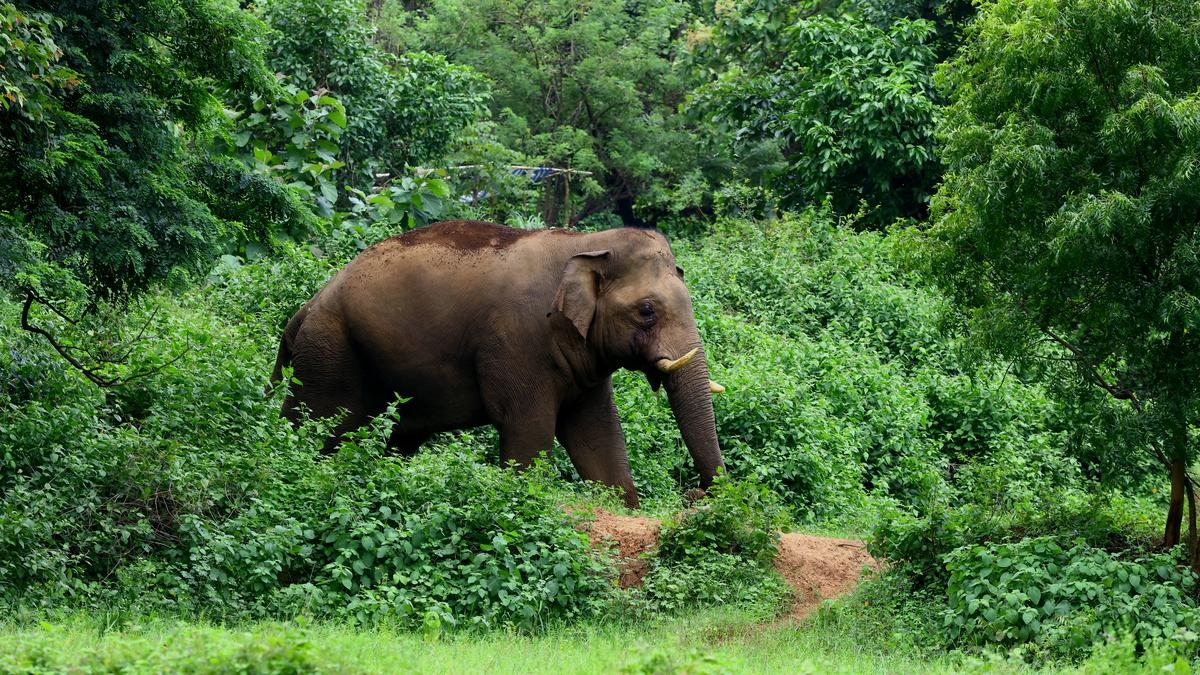
The Wildlife Institute of India released the first-ever DNA-based synchronous estimation of elephants across the country
1. Background
Released by: Wildlife Institute of India (WII) on October 14, 2025.
Based on: Synchronous All-India Elephant Estimation (SAIEE) 2021–25.
Estimate: 22,446 elephants across four landscapes.
Previous estimate (2017): 29,964 elephants.
Note: The decline cannot be directly compared due to change in methodology — the new DNA-based method serves as a fresh baseline for future estimates.
Almost 60% of India’s elephants are in Karnataka, Assam, Tamil Nadu
2. Evolution of Elephant Census in India
Period | Method Used | Remarks |
1929–1978 | Direct total count | Visual counts, averaged across 10-day intervals. |
1992 (Project Elephant) | Multi-method (total count, tracking, registration, dung count, waterhole count, etc.) | Introduced systematic population monitoring. |
2005–2017 | Synchronised Elephant Census | Used total count, sample block count, dung count, and waterhole count. |
2021–25 (SAIEE) | DNA-based dung analysis + spatial mapping | Standardized national framework eliminating regional bias. |
3. SAIEE 2021–25 Methodology
Country divided into 100 sq. km cells, further into 4 sq. km grids, each uniquely coded for consistent tracking.
Enumerators covered:
6,66,977 km on foot.
1,88,030 transects and trails.
Collected 21,056 dung samples.
Conducted in 3 phases:
Phase I: Data on animal signs, ungulate abundance, vegetation, human disturbance.
Phase II: Habitat & anthropogenic impacts (vegetation cover, patch size, human footprint).
Phase III: Spatial abundance estimation integrating human and habitat variables.
4. Regional Distribution of Elephants (2025)
Landscape | States Covered | Elephants | Share (%) | Key State |
Western Ghats | Karnataka, Kerala, Tamil Nadu | 11,934 | 53.17% | Karnataka (6,013) Karnataka led the chart with 6,013 elephants, followed by Tamil Nadu with 3,136 and Kerala with 2,785 elephants |
Northeast Hills & Brahmaputra Floodplains | NE States + N. West Bengal | 4,990 | 22.22% | Assam (4,159) Assam topped the table here with 4,159 elephants. |
Shivalik Hills & Gangetic Plains | Uttarakhand, U.P., Bihar | 2,061 | 9.18% | Uttarakhand (1,792) |
Central India & Eastern Ghats | Odisha, A.P., Maharashtra, Telangana, Chhattisgarh, Jharkhand, S. W.B. | 1,890 | 8.42% | Odisha (912) |
5. Key Findings & Concerns
Habitat fragmentation from:
Expansion of coffee & tea plantations.
Invasive plant species.
Fencing of farmlands & mining.
Infrastructure and developmental projects.
Migration and conflict:
Elephants have re-entered areas (e.g., Andhra Pradesh) after 200 years.
Migratory herds from Tamil Nadu & Karnataka (1980–86) led to new human-elephant conflict zones.
Conflict hotspots:
Karnataka: Bandipur–Nagarhole–BRT region (fires, eucalyptus/acacia plantations).
Kerala: High conflict intensity in forest–farm interfaces.
Tamil Nadu: Nilgiris–Coimbatore Division — 150 human & 170 elephant deaths recorded.
6. Conservation Implications
Need for community sensitisation in both traditional and new elephant zones.
Integration of local communities in mitigation and compensation schemes.
Scientific management using DNA-based tracking for long-term monitoring.
Landscape-level planning to ensure elephant corridors and reduce fragmentation.