
Strait of Hormuz Strategic importance
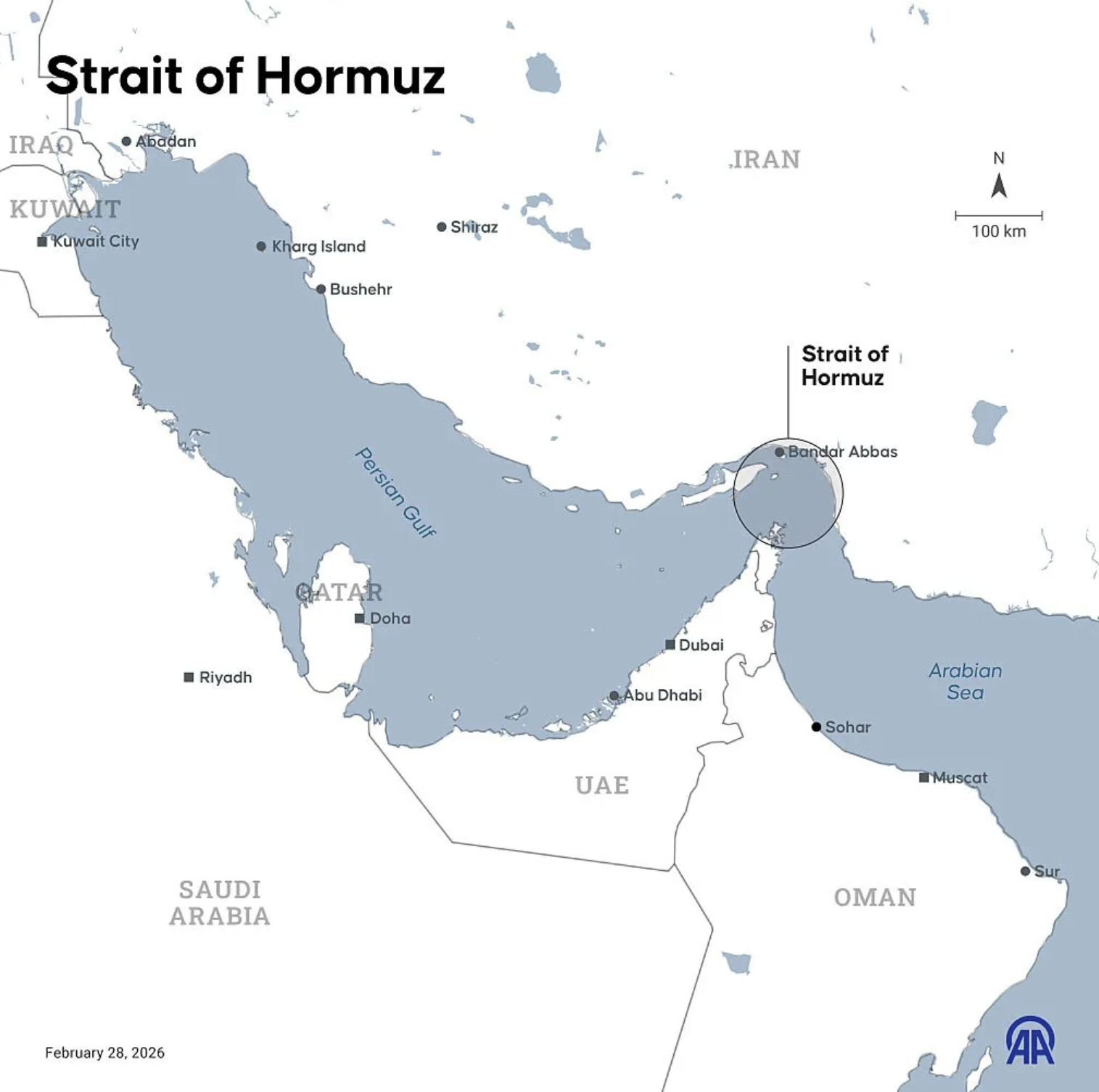
Location and geography
The Strait of Hormuz is a narrow maritime passage connecting the Persian Gulf with the Gulf of Oman and the Arabian Sea.
It lies between Iran (north) and Oman and the UAE (south).
The strait is about 33 km wide at its narrowest point.
Strategic importance
One of the world’s most critical energy chokepoints.
Around 20% of global oil and gas trade passes through the strait.
Nearly 40% of India’s oil imports transit through this route.
Major exporters using this route include:
Saudi Arabia
Iraq
Kuwait
Qatar
Iran
Because a large portion of global energy flows through this narrow passage, any disruption can significantly affect global energy markets and shipping routes.

Other important global maritime chokepoints
Key chokepoints affecting global trade include:
Malacca Strait – Between Malaysia and Indonesia; crucial for East Asian trade.
Bab-el-Mandeb – Connects the Red Sea with the Gulf of Aden.
Suez Canal – Artificial canal linking the Mediterranean Sea with the Red Sea.
Panama Canal – Artificial canal linking the Atlantic and Pacific Oceans.
Bosphorus and Dardanelles – Connect the Black Sea to the Mediterranean Sea through the Sea of Marmara.
These chokepoints are essential for energy transport, global trade, and naval movement.
Current situation in the Strait of Hormuz
Following military tensions between the United States, Israel, and Iran, shipping traffic has sharply declined.
Ship movement across the strait has reduced by around 95%.
Several ships have been attacked or threatened near the passage.
Around 600 vessels are stranded in the region, including:
Oil tankers
Gas carriers
Bulk cargo vessels
Due to the risks:
Insurance premiums have increased 10–15 times.
Shipping companies are reluctant to transit through the strait.
Can the strait legally be closed?
International law treats oceans largely as global commons.
Ships have the right of innocent passage through international straits.
No single country can legally close the Strait of Hormuz.
However, security threats, military conflict, and attacks on vessels can effectively disrupt shipping even without a formal closure.
Iran’s strategic leverage
Iran lies along the northern coast of the strait and maintains a strong naval presence.
Groups such as the Islamic Revolutionary Guard Corps (IRGC) have threatened ships transiting the passage.
Iran has historically used this chokepoint as strategic leverage, for example during the Iran–Iraq War in the 1980s.
By threatening shipping, Iran aims to increase global pressure on the U.S. and Israel to de-escalate conflicts.
Alternative routes
Some alternatives exist but are limited:
Saudi pipelines to the Red Sea port of Yanbu can bypass Hormuz.
However, shipping in the Red Sea is also risky due to Houthi attacks near Bab-el-Mandeb.
Thus, Hormuz remains extremely difficult to replace as a major energy corridor.

Impact on India
The disruption has several implications for India’s economy.
Oil imports
Around 40% of India’s crude oil imports pass through the Strait of Hormuz.
Any disruption could raise global oil prices, increasing inflation and fuel costs.
Liquefied Natural Gas (LNG)
Qatar supplies about half of India’s LNG imports.
LNG is used for:
Power generation
City gas distribution
Industrial use
Fertilizer production
Around 30% of India’s natural gas is used to produce fertilizers.
LNG supply disruptions may affect ammonia and fertilizer production.
Liquefied Petroleum Gas (LPG)
Around 60% of India’s LPG consumption is imported.
LPG is widely used for domestic cooking fuel, making shortages politically and economically sensitive.
Government measures
India has taken several steps to manage the situation:
Diversifying energy sources
Seeking LNG from the United States, Russia, and Australia.
Increased Russian oil imports
Temporary permission from the U.S. to purchase Russian crude oil.
Refinery adjustments
Tweaking refining processes to produce more propane and butane for LPG supply.
Maritime insurance support
India is exploring insurance backing through U.S. agencies to reduce shipping risks.
Economic implications
Higher global oil prices may increase fuel prices in India.
This could lead to:
Higher transportation costs
Inflationary pressure
Economic slowdown
Prelims practice MCQs
Q. With reference to the Strait of Hormuz, consider the following statements:
It connects the Persian Gulf with the Gulf of Oman.
It lies between Iran on the north and Oman and the UAE on the south.
It is an artificial canal constructed to facilitate oil transport.
Which of the statements given above are correct?
A. 1 and 2 only
B. 2 only
C. 1 and 3 only
D. 1, 2 and 3
Answer: A
Explanation:
Statement 1: Correct — The strait connects the Persian Gulf to the Gulf of Oman and Arabian Sea.
Statement 2: Correct — It lies between Iran and Oman/UAE.
Statement 3: Incorrect — It is a natural strait, not an artificial canal.
Q. Which of the following maritime chokepoints connects the Red Sea with the Gulf of Aden?
A. Strait of Malacca
B. Bab-el-Mandeb
C. Bosphorus
D. Dardanelles
Answer: B
Explanation:
Bab-el-Mandeb is the narrow passage linking the Red Sea with the Gulf of Aden and the Arabian Sea.
Q. Consider the following pairs:
Strait / Canal | Connecting Water Bodies |
1. Bosphorus | Black Sea – Sea of Marmara |
2. Dardanelles | Sea of Marmara – Mediterranean Sea |
3. Suez Canal | Mediterranean Sea – Red Sea |
4. Panama Canal | Atlantic Ocean – Pacific Ocean |
Which of the pairs given above are correctly matched?
A. 1 and 2 only
B. 2 and 3 only
C. 1, 3 and 4 only
D. 1, 2, 3 and 4
Answer: D
Explanation:
All pairs are correct and represent important maritime connections for global trade.
Q. With reference to India’s energy imports, consider the following statements:
About 40% of India’s crude oil imports pass through the Strait of Hormuz.
Qatar supplies about half of India’s liquefied natural gas (LNG) imports.
Nearly one-third of India’s natural gas is used in fertilizer production.
Which of the statements given above are correct?
A. 1 only
B. 1 and 2 only
C. 2 and 3 only
D. 1, 2 and 3
Answer: D
Explanation:
About 40% of India’s oil imports pass through Hormuz.
Qatar supplies roughly half of India’s LNG imports.
Around 30% of India’s natural gas is used in fertilizer production.