
Super Garuda Shield 2025
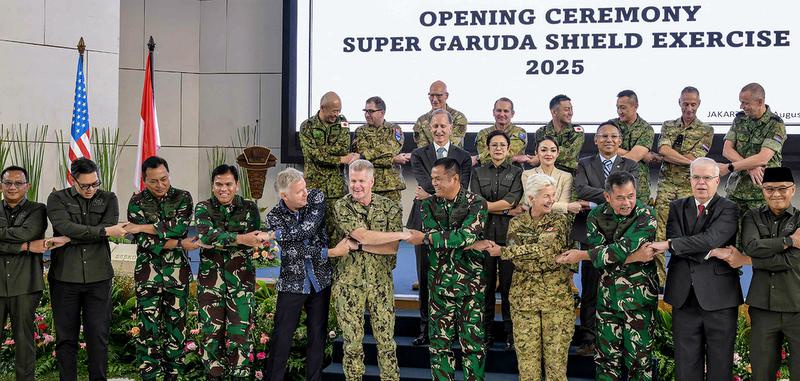
What Happened?
-
Indonesia & U.S. launched annual joint military drills in Jakarta (Aug 25 – Sept 4, 2025).
-
Exercise has been held every year since 2009, expanded since 2022.
Participants
-
Main hosts: Indonesia + United States.
-
Other active participants (12 nations): Australia, Japan, Singapore, UK, France, Canada, Germany, Netherlands, New Zealand, Brazil, South Korea.
-
Observers: Countries including India, Papua New Guinea and East Timor also sent observers for the exercise.
-
Troops involved: ~6,500.
Purpose
-
Strengthening regional security ties in an unstable global landscape.
-
Building interoperability among forces.
-
Sending a message of deterrence against aggression (esp. in the Indo-Pacific).
Context & Geopolitical Background
1. China’s Role
-
Jakarta concerned about Chinese encroachment in its Exclusive Economic Zone (South China Sea).
-
However, Indonesia balances relations → positive economic ties with Beijing continue.
-
China accuses the U.S. of trying to form an “Asian NATO.”
2. U.S. Strategy
-
Expanding military alliances in Indo-Pacific to reassure allies.
-
Warns countries against relying on China economically while seeking U.S. military support (Defense Secretary Pete Hegseth in Singapore speech).
3. Indonesia’s Dual-Track Diplomacy
-
Defence diversification, not alignment:
-
Expands exercises with the U.S. & Western allies.
-
Purchases U.S. & French arms.
-
Keeps disputes with China mostly behind closed doors due to heavy Chinese trade & investment.
-
Analysts say this non-alignment strategy may actually be Indonesia’s strength in a tense region.
Why This Matters
-
For the region: Reinforces the U.S.-led security network in Asia amid South China Sea tensions.
-
For Indonesia:
-
Boosts military capability without openly siding against China.
-
Maintains flexibility in foreign policy.
-
-
For China: Another signal of growing pushback against its regional assertiveness.