
Supreme Court on POSH Act & Political Parties
Case Background
-
Issue: Exclusion of women political workers from the scope of the POSH Act, 2013 (Sexual Harassment of Women at Workplace Act).
-
Relief Sought:
-
Declaration that political parties and their affiliates are “employers” under the POSH Act.
-
Inclusion of grassroots political workers under the Act’s protection framework.
-
Supreme Court Decision
-
Headed by Chief Justice B.R. Gavai
-
Allowed withdrawal of the plea.
-
Direction: Petitioner is free to explore other legal remedies or take steps as per law.
-
Discriminatory Exclusion: Women in politics face similar or greater risks of sexual harassment, particularly during campaigns and internal party work.
-
Lack of Legal Redressal: POSH Act currently does not cover political parties explicitly under definitions of "workplace" or "employer".
-
Constitutional Angle: Argued that such exclusion violates Article 14 (equality) and Article 21 (dignity and personal liberty).
| Provision | Details |
|---|---|
| Objective | Prevent and redress sexual harassment of women at workplace |
| Section 2(o): Workplace | Includes organized and unorganized sectors; broad but not exhaustive |
| Section 2(g): Employer | Covers individuals managing the workplace, but political parties not named |
| Section 4 | Mandates constitution of Internal Complaints Committee (ICC) |
| Section 6 | District Officer to form Local Complaints Committee (LCC) for unorganized sectors |
| Section 9 | Time limit of 3 months for filing complaints. (The Internal Committee (IC) or Local Committee (LC) can extend this period by a maximum of 3 more months if there are valid reasons, recorded in writing, for the delay. ) |
| Section 10-13 | Inquiry procedure, interim relief, and disciplinary actions |
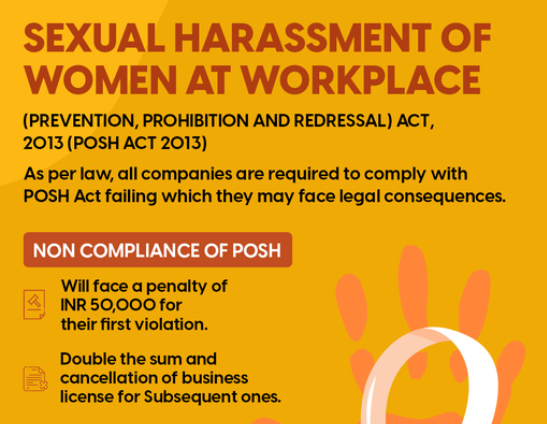
| Penalty for Non-Compliance | Fine up to ₹50,000, cancellation of license for repeat offence (Section 26) |
-
The Act does not mention any age bar:
-
Applies to all women, including minors and elderly, who experience harassment in a workplace setting.
-
-
Applies regardless of the woman's employment status – includes interns, volunteers, contractual staff.(also covers Ngos,domestic workers)
-
Political parties and religious institutions are not explicitly included as workplaces.
-
Domestic workers are only partially covered under LCC, with weak enforcement mechanisms.
-
Men and persons of other genders not covered as victims under this Act (gender-specific).
| Case | Significance |
|---|---|
| Vishaka v. State of Rajasthan (1997) | Laid down Vishaka Guidelines, basis for POSH Act |
| Medha Kotwal Lele v. Union of India (2013) | Reiterated the binding nature of Vishaka Guidelines until the law is passed |
| Apparel Export Promotion Council v. A.K. Chopra (1999) | Upheld employer’s duty to protect dignity of women at workplace |
| Dr. Punita K. Sodhi v. Union of India (2010) | Stressed need for natural justice and fair inquiry under POSH |
| Shefali Tripathi v. Union of India (2022) | Addressed false complaints and importance of institutional safeguards |
-
The case raises questions about the need to expand the POSH Act’s definitions to reflect non-traditional workplaces like:
-
Political parties
-
Campaign trails
-
Volunteer-driven organizations
-
-
Suggests a need for amendments or new guidelines covering grassroots-level political workers, particularly women.
-
Reopens debate on gendered safety in politics and public life.