
Tamil Nadu Chief Minister opposed the exemption of atomic mineral mining from public consultation
Context
-
Issue: Union Ministry of Environment, Forest and Climate Change (MoEFCC) issued an Office Memorandum (8 September 2025) exempting atomic, critical, and strategic mineral mining from mandatory public consultation under EIA process.
Key Concerns Raised by Tamil Nadu CM
-
Violation of Federal Spirit
-
Policy decisions of such magnitude must be debated in Parliament, State Legislatures, and through public consultations.
-
Bypassing States and communities contradicts cooperative federalism.
-
-
Ecological Sensitivity of Tamil Nadu Coasts
-
Rich deposits of rare earth elements in beach sand.
-
Coastal ecosystems: Gulf of Mannar, Palk Bay.
-
Ecological features: turtle nesting grounds, coral reefs, mangroves, sand dunes.
-
Functions: biodiversity conservation, shoreline stabilization, carbon sequestration, natural defense against cyclones and erosion.
-
-
Livelihood and Social Concerns
-
Coastal communities depend on these ecosystems.
-
Exempting consultations removes their right to voice concerns on livelihood loss, displacement, environmental degradation.
-
-
Democratic and Legal Safeguards
-
EIA Notification, 1994 (amended 1997): introduced mandatory public hearings.
-
EIA Notification, 2006: reinforced safeguard.
-
Exemption weakens participatory democracy and environmental governance principles.
-
Broader Implications
-
Environmental Risk: Atomic and rare earth mineral mining has radioactive and ecological hazards.
-
Policy Concern: Strategic mineral needs vs. environmental justice.
-
Governance Issue: Central unilateralism vs. State rights in natural resource management.
-
Community Rights: Undermines free, prior, and informed consent (FPIC) principle recognized internationally.
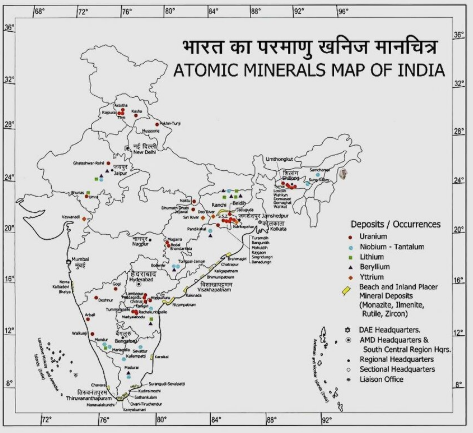
Atomic & Strategic Minerals in India (2025)
| Mineral | Main States | Latest Official Resource / Note |
|---|---|---|
| Uranium (U₃O₈) | Andhra Pradesh, Jharkhand, Rajasthan, Karnataka, Telangana, Meghalaya, Chhattisgarh, Maharashtra | ~4.3 lakh tonnes in-situ resource (2024–25) |
| Thorium (in Monazite) | Andhra Pradesh, Odisha, Tamil Nadu, Kerala, West Bengal, Bihar, Maharashtra, Gujarat | Monazite resources ~11.93 million tonnes (bearing thorium & REEs) |
| Rare Earth Elements (REEs) | Andhra Pradesh, Odisha, Tamil Nadu, Kerala, West Bengal | Occur mainly in monazite placers; |
| Lithium | Jammu & Kashmir (Reasi district, Salal–Haimana), Rajasthan's Degana region Karnataka, Jharkhand, and parts of Odisha, Chhattisgarh, and the Rann of Kutch | 5.9 million tonnes (inferred, G3 resource) |
| Zircon / Zirconium | Kerala, Tamil Nadu, Odisha, Andhra Pradesh | Occur in beach sand placers with ilmenite, rutile, garnet |
| Ilmenite, Rutile, Garnet (associated sands) | Kerala, Tamil Nadu, Odisha, Andhra Pradesh | Large placer resources (hundreds of million tonnes for ilmenite) |
| Beryllium | Rajasthan, Jharkhand, Odisha (scattered occurrences) | Known small deposits in pegmatites; |