
Tax reforms (GST revamp + new Income-Tax Bill):
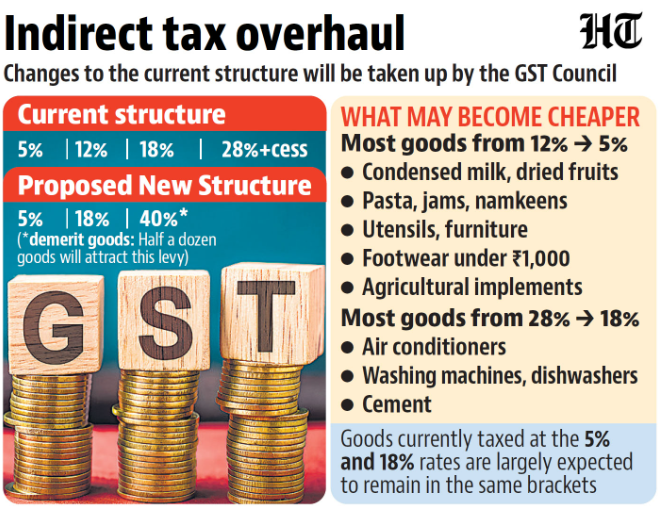
Key Features of Proposed GST Reform
-
New GST Structure
-
Two-tier GST: 5% and 18%.
-
40% slab for sin goods (tobacco, luxury liquor, etc.).
-
Abolition of 12% and 28% slabs.
-
Removal of compensation cess.
-
-
Inclusion of Petroleum Products
-
Petrol & diesel under GST deferred due to energy price volatility.
-
May be considered in next round of reforms.
-
-
Rate Rationalisation
-
Cement: 28% → 18% (expected to cut real estate & infra costs).
-
Automobiles & auto parts: 28% → 18% (boost demand & reduce costs).
-
Luxury/ultra-premium cars may continue to face higher incidence.
-
-
Institutional Strengthening
-
Simplified input tax credit (ITC) system.
-
Stronger GST tribunals for dispute resolution.
-
Income-Tax Bill (Direct Tax Overhaul)
-
Recently passed by Parliament; forms part of a complete revamp of direct + indirect tax system.
-
Aimed at simplification, widening tax base, and reducing compliance burden.
Government’s Position
-
PM Modi: Draft circulated to states; seeks rollout before Diwali 2025.
-
Framed as “reform with good governance”, intended to ease life & business.
-
Fiscal deficit target for FY26: 4.4% of GDP, despite expected revenue dip.
Impact Assessment
1. On Consumers
-
Lower tax burden on essentials & big-ticket items like housing and vehicles.
-
Cheaper cement → reduced housing & infrastructure costs.
-
Cheaper auto parts → reduced maintenance costs.
-
Lower duty burden likely to increase affordability.
2. On Businesses
-
Reduced rates → potential demand boost in auto, housing, infra sectors.
-
Simpler ITC regime → easier compliance for MSMEs & large firms.
-
Anti-profiteering provisions relaxed; extent of consumer benefit depends on market pass-through.
3. On States & Revenues
-
Short-term revenue loss (e.g., ₹33,000 crore from cement + auto rate cut).
-
Long-term gain from higher consumption demand and tax buoyancy.
-
States benefit politically by showcasing reduced tax burden on citizens.
4. On Overall Economy
-
Housing push aligns with government’s affordable housing & infra expansion targets.
-
Auto demand revival could support manufacturing & jobs.
-
Rationalisation seen as pro-consumer, pro-growth, while maintaining fiscal prudence.