
Technology Perspective and Capability Roadmap (TPCR-2025)
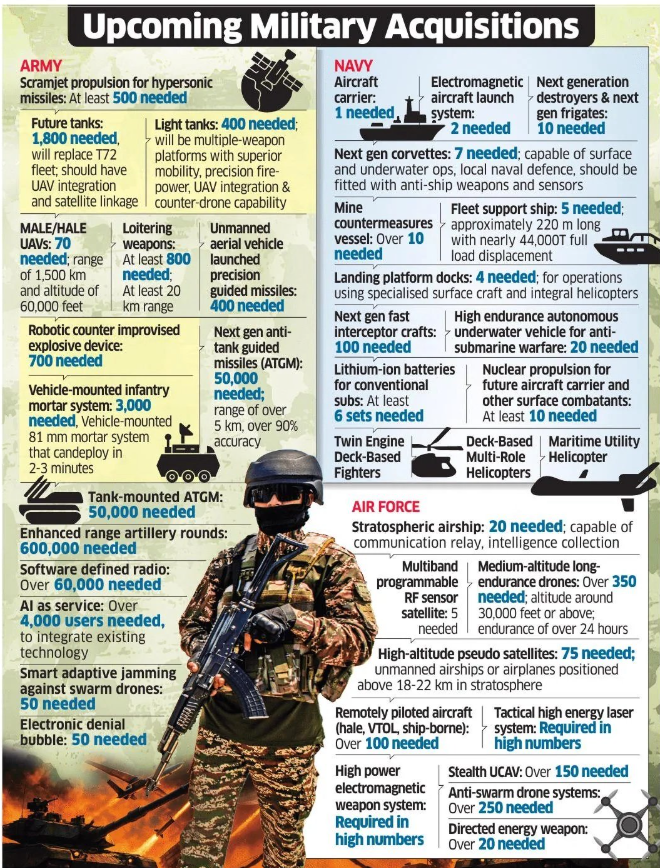
Context: India has set out an ambitious plan to reinforce its nuclear deterrence and expand drone warfare capabilities under the Technology Perspective and Capability Roadmap (TPCR-2025)
Overview
-
Nature: A 15-year blueprint for India’s military preparedness.
-
Aim: Strengthen nuclear deterrence and expand drone warfare capabilities.
-
Strategic Shift: Towards integrated deterrence — blending nuclear resilience, electronic warfare, and unmanned platforms.
-
Alignment: Consistent with the government’s self-reliance (Atmanirbhar Bharat) push in defence production.
Nuclear Deterrence Strengthening
-
Focus: Sustaining credible nuclear deterrence through:
-
Survivability systems.
-
Advanced delivery platforms (no mention of specific warhead tech).
-
-
Future acquisitions:
-
Nuclear command-and-control infrastructure.
-
Radiation detection tools.
-
Mobile decontamination units.
-
Unmanned ground vehicles for CBRN reconnaissance.
-
-
Objective: Enhanced resilience against nuclear/chemical fallout.
Drone Warfare Capabilities
-
Stealth Remotely Piloted Aircraft (RPAs):
-
Range up to 1,500 km.
-
Operating altitude 60,000 ft.
-
Payloads: Electronic warfare systems, CBRN detection equipment, artillery guidance.
-
-
Loitering Munitions (Suicide Drones):
-
AI-enabled precision targeting.
-
Reusable warhead systems.
-
-
Integrated Surveillance & Targeting Drones:
-
To enhance mechanised forces’ battlefield capabilities.
-
Counter-Drone Strategy
-
Threat: Hostile drone swarms.
-
Countermeasures:
-
Adaptive jamming systems.
-
Electronic denial bubbles (radius 15 km) to neutralise swarm attacks.
-
Strategic Importance
-
Marks transition from traditional deterrence to multi-domain deterrence.
-
Integrates nuclear, electronic, and unmanned systems for future warfare.
-
Strengthens India’s defence self-reliance, reducing foreign dependency.
-
Positions India to deal with next-gen threats in regional and global security environments.