
Thailand–Cambodia border dispute and ASEAN role
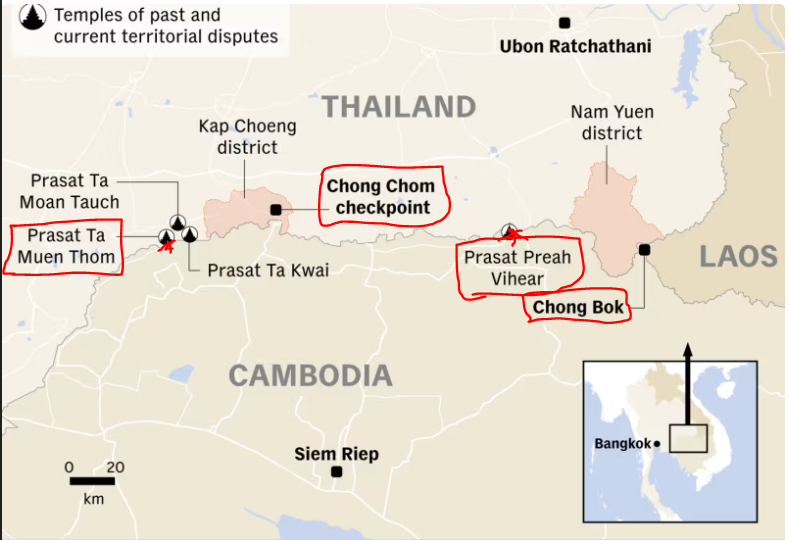
Background of the Conflict
The Thailand–Cambodia border dispute centres on the Preah Vihear Temple region located along the Dângrêk mountain ranges.
Colonial-era Franco–Siamese Treaties (1904 & 1907) drew boundaries ambiguously, leaving demarcation unresolved.
1962: International Court of Justice (ICJ) awarded Cambodia sovereignty over the temple, but territorial disputes around adjoining land persist.
Recent Escalation
The U.S. brokered a truce (Trump + Malaysian PM Anwar Ibrahim), but:
May: Cambodian soldier killed; Cambodia bans Thai goods, closes borders.
July: Five Thai soldiers injured in landmine explosion → Thailand blames Cambodia.
Five days of cross-border fighting → 48 killed, 3,00,000 displaced.
Thailand suspends the ceasefire after new landmine blast.
Dec 7: Cambodia accuses Thailand of air strikes → truce collapses.
Strategic & Regional Implications
Two ASEAN members in conflict weaken ASEAN credibility.
The region is already strained due to the Myanmar crisis.
Conflict threatens:
Regional stability
Tourism & investor confidence
ASEAN’s image as a zone of security & economic cooperation
ASEAN’s Role & Limitations
ASEAN’s engagement is non-intrusive due to the principle of non-interference.
Malaysia & Indonesia have leverage and prior mediation experience.
ASEAN must push dialogue, restore ceasefire, and build confidence-building measures to prevent recurrence.
Dângrêk Mountains
Location
A forested hill range forming a natural boundary between Thailand and Cambodia.
East–west trending range extending ~200 miles (≈320 km) from the Mekong River westwards to the San Kamphaeng highlands in Thailand.
Geological Features
Represents the southern escarpment of the sandstone Khorat Plateau (Northeastern Thailand).
Northward slope: gentle, towards the Mun River basin (Thailand).
Southward slope: steep, descending abruptly into the Cambodian plains.
Altitude
Average elevation: 1,500–2,000 feet (450–600 m).
Highest point: 2,497 feet (761 m).
Strategic Importance
Forms the disputed border zone between Thailand and Cambodia.
Home to the Preah Vihear Temple, a major flashpoint in bilateral disputes.
Terrain difficult, forested → historically used in insurgencies and landmine-laying.
ASEAN
Origins and Establishment
ASEAN (Association of Southeast Asian Nations) was established on 8 August 1967 in Bangkok, Thailand.
Created through the ASEAN Declaration (Bangkok Declaration).
Founding Members (1967):
Indonesia
Malaysia
Philippines
Singapore
Thailand
Founding Fathers (Foreign Ministers):
Adam Malik (Indonesia)
Narciso R. Ramos (Philippines)
Tun Abdul Razak (Malaysia)
S. Rajaratnam (Singapore)
Thanat Khoman (Thailand)
These leaders are regarded as architects of one of the most successful inter-governmental organisations in the developing world.
Membership Expansion
Brunei Darussalam → 7 January 1984
Viet Nam → 28 July 1995
Lao PDR → 23 July 1997
Myanmar → 23 July 1997
Cambodia → 30 April 1999
➡️ ASEAN today consists of 10 Member States.
ASEAN Charter (2008)
Entered into force on 15 December 2008 in Jakarta, in presence of ASEAN Foreign Ministers.
Gives legal personality to ASEAN and provides a rules-based institutional framework.
The Charter is a legally binding agreement among all 10 Member States.
It is registered with the UN Secretariat under Article 102(1) of the UN Charter.
Importance of the ASEAN Charter
New political commitment at highest level
Enhanced commitments for cooperation
Legal framework + legal personality
Establishes new ASEAN organs
Provides two openly-recruited Deputy Secretary-Generals (DSGs)
Leads to more ASEAN meetings
Enhances roles of:
ASEAN Foreign Ministers
Secretary-General of ASEAN
Supports ASEAN’s goal of building the ASEAN Community.
ASEAN Summit
Highest policy-making body of ASEAN.
Composed of Heads of State/Government of ASEAN Member States.
Held twice annually.
Hosted by the Member State holding ASEAN Chairmanship.
First ASEAN Summit:
Bali, Indonesia, on 23–24 February 1976.
Prelims Practice MCQs
Q. Consider the following statements about ASEAN’s role in regional security:
ASEAN’s non-interference principle often limits its ability to mediate in bilateral conflicts between member states.
ASEAN is simultaneously dealing with crises in Myanmar and on the Thai–Cambodia border.
ASEAN has a formal mechanism that allows it to deploy peacekeeping forces within member states without their consent.
Which of the above statements is/are correct?
a) 1 and 2 only
b) 2 and 3 only
c) 1 and 3 only
d) All three
Answer: a) 1 and 2 only
Explanation:
S1 – Correct: The principle hinders intervention.
S2 – Correct: Myanmar & Thai–Cambodia tensions coexist.
S3 – Incorrect: ASEAN has no compulsory peacekeeping mechanism and cannot deploy forces without consent.
Q. Consider the following statements about ASEAN:
ASEAN was founded in 1967 with Indonesia, Malaysia, Philippines, Singapore, and Thailand as its original members.
The ASEAN Charter, which came into force in 2008, gives ASEAN a legal personality.
The first ASEAN Summit was held in Bangkok in 1967.
How many of the above statements are correct?
a) Only one
b) Only two
c) All three
d) None
Correct Answer: b) Only two
Explanation
S1 – Correct: These were the 5 founding countries.
S2 – Correct: The Charter (2008) gives ASEAN legal personality.
S3 – Incorrect: The first ASEAN Summit was held in Bali in February 1976, not in Bangkok.
Q. The Dângrêk Mountains are significant in Southeast Asian geopolitics primarily because:
a) They form the watershed between the Salween and Mekong rivers.
b) They contain major oil reserves shared by Cambodia and Thailand.
c) They are the region around which disputes over the Preah Vihear temple are situated.
d) They mark the eastern end of the Indo-Burman ranges.
Correct Answer: c) They are the region around which disputes over the Preah Vihear temple are situated.
Explanation:
The Preah Vihear Temple, a UNESCO World Heritage Site, sits on a cliff of the Dângrêk range and has been the centre of Thailand–Cambodia territorial disputes.
Q. Which of the following geographical features correctly describes the Dângrêk range?
a) A volcanic mountain chain forming part of the Pacific Ring of Fire.
b) A sandstone escarpment separating the Khorat Plateau from the Cambodian lowlands.
c) A fold mountain system formed by the collision of the Indo-Australian and Eurasian plates.
d) A coastal mountain chain along the Gulf of Thailand.
Correct Answer: b) A sandstone escarpment separating the Khorat Plateau from the Cambodian lowlands.
Explanation:
Dângrêk is a sandstone escarpment that marks the southern boundary of the Khorat Plateau and descends into the Cambodian plain.