
The path to ending global hunger runs through India
Context
-
Global Undernourishment:
-
2024 → 673 million people undernourished (8.2% of world population).
-
2023 → 688 million; 2018 (pre-pandemic) → 7.3%.
-
Decline marks reversal of COVID-19-driven spike.
-
-
India’s Contribution:
-
Undernourishment in India declined from 14.3% (2020–22) to 12% (2022–24).
-
~30 million fewer people hungry.
-
Progress attributed to reforms in Public Distribution System (PDS), digitalisation, and targeted nutrition schemes.
-
1. Transformation of PDS
-
Digitalisation & Targeting: Aadhaar-enabled, biometric authentication, ePOS devices, real-time inventory tracking.
-
ONORC (One Nation One Ration Card): Enabled portability of benefits, especially for migrants.
-
Scale: Over 800 million people covered.
-
Impact: Ensured food access during pandemic disruptions.
2. From Calories to Nutrition
-
Challenges:
-
Cost of healthy diet remains unaffordable for 60% of Indians.
-
Price of nutrient-rich foods, weak cold chains, and poor market linkages.
-
Rise in malnutrition, obesity, and micronutrient deficiencies despite calorie sufficiency.
-
-
Initiatives:
-
PM POSHAN (2021): School-feeding with focus on dietary diversity.
-
Integrated Child Development Services (ICDS): Nutrition-sensitive interventions.
-
Focus shifting from filling stomachs to improving nutritional quality.
-
3. Structural Reforms Needed in Agrifood System
-
Boost nutrient-rich food production (pulses, fruits, vegetables, animal-based foods).
-
Post-harvest infrastructure: Cold storage, digital logistics to cut 13% food loss.
-
Support women-led enterprises & FPOs, especially in climate-resilient crops.
-
Leverage digital tools:
-
AgriStack: Data-driven farm support.
-
e-NAM: Market access for farmers.
-
Geospatial tools: Better planning & targeting.
-
4. India’s Global Role
-
India’s success is a “global public good”.
-
Acts as a model for Global South → showcasing innovations in digital governance, social protection, and data-driven agriculture.
-
Critical for achieving SDG 2: Zero Hunger by 2030.
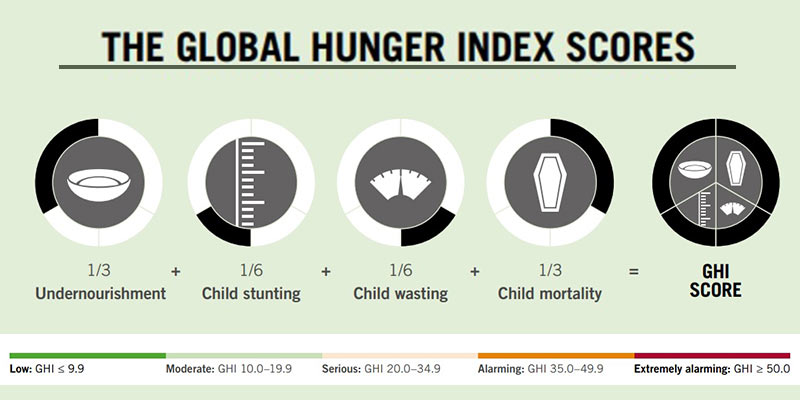
- India ranks 105th out of 127th countries, falling under "serious" category with 41 other nations, including Pakistan and Afghanistan.
5. Overall
-
India has moved from being a food-deficit country to a food-security leader.
-
Future challenge: From sustenance to nutrition, resilience, and opportunity.
India ranks 105th out of 127th countries, falling under "serious" category with 41 other nations, including Pakistan and Afghanistan.
India’s GHI score has fallen since 2000, however, child wasting and stunting remain very high.
-
FAO underscores: “The path to ending global hunger runs through India.”