
The Scientist Who Made ‘Mangroves’ a Buzzword – M.S. Swaminathan’s Contributions
Background & Significance
-
M.S. Swaminathan, pioneering agricultural scientist, and former Executive Director of the M.S. Swaminathan Research Foundation (MSSRF).
-
Primary Contribution: Elevated mangroves from a neglected ecosystem to a global symbol of ecological protection and climate adaptation.
-
Four decades of work in mangrove research, management, and policy advocacy.
Turning Point in Global Recognition
-
1988: UNDP and UNESCO initiated a regional mangrove research project.
-
1989: M.S. Swaminathan highlighted mangroves' role in climate resilience at a conference in Tokyo:
-
Explained risks from sea level rise, cyclones, salinisation, and loss of livelihoods.
-
Proposed sustainable mangrove management based on:
-
Ecology
-
Economics
-
Equity
-
Biogenetic innovation: e.g., transferring salinity-tolerance genes from mangroves to crops like rice.
-
-
International Impact
a. Establishment of ISME (1990)
-
International Society for Mangrove Ecosystems, Okinawa, Japan.
-
M.S. Swaminathan as Founding President (1990–1993).
b. Charter for Mangroves (1992)
-
Incorporated into the World Charter for Nature (UN Conference on Environment and Development, 1992).
-
Continues to serve as a global framework for mangrove conservation.
c. Key Activities of ISME
-
Valuation of mangrove ecosystems (economic & ecological).
-
Workshops, manuals for restoration, and the World Mangrove Atlas.
-
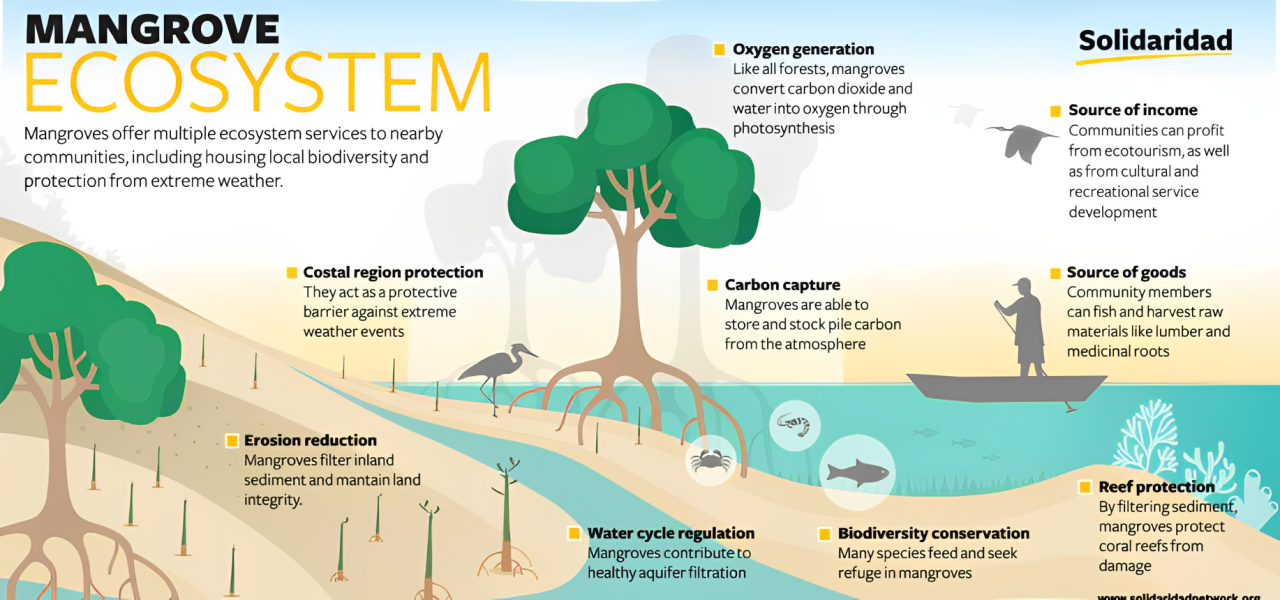
Shifted perception of mangroves from “marshy wastelands” to multi-use coastal ecosystems.
d. GLOMIS (Global Mangrove Database and Information System)
-
Developed under M.S. Swaminathan’s guidance.
-
A global repository on:
-
Mangrove experts, species, and research.
-
Documented mangrove genetic resources.
-
e. Establishment of Mangrove Genetic Resource Centres (1992)
-
Survey of 23 mangrove sites across 9 countries in South & Southeast Asia and Oceania.
-
These sites are now Protected Areas, managed by respective national governments.
National Impact in India
a. Historical Background
-
Mangrove management in India dates back to 1783 (Sundarbans).
-
Clear-felling for agriculture and settlements during British period.
-
Continued till 1980, when Forest (Conservation) Act was passed.
b. MSSRF’s Role Post-1980
-
Research highlighted degradation due to clear-felling, not local communities.
-
Developed the hydro-ecological ‘fishbone canal’ method of mangrove restoration.
-
Tested in Tamil Nadu, Andhra Pradesh, Odisha, West Bengal.
-
c. Joint Mangrove Management (JMM) Programme
-
Evolved from MSSRF initiatives.
-
Evaluated and recommended by Ministry of Environment and Forests in 2000.
-
Led to greater Central and State investment in mangrove conservation.
Impact of Natural Disasters
-
Mangroves played a protective role during:
-
1999 Odisha Super Cyclone.
-
2004 Indian Ocean Tsunami.
-
-
Reinforced their disaster mitigation capacity and ecological importance.
Present Status and Recognition
a. World Mangrove Day
-
Celebrated annually on July 26 to raise awareness.
b. India State of Forest Report (ISFR) 2023
-
Total mangrove cover: 4,991.68 sq. km, i.e., 0.15% of India’s geographical area.
-
Net increase since ISFR 2019: +16.68 sq. km.