
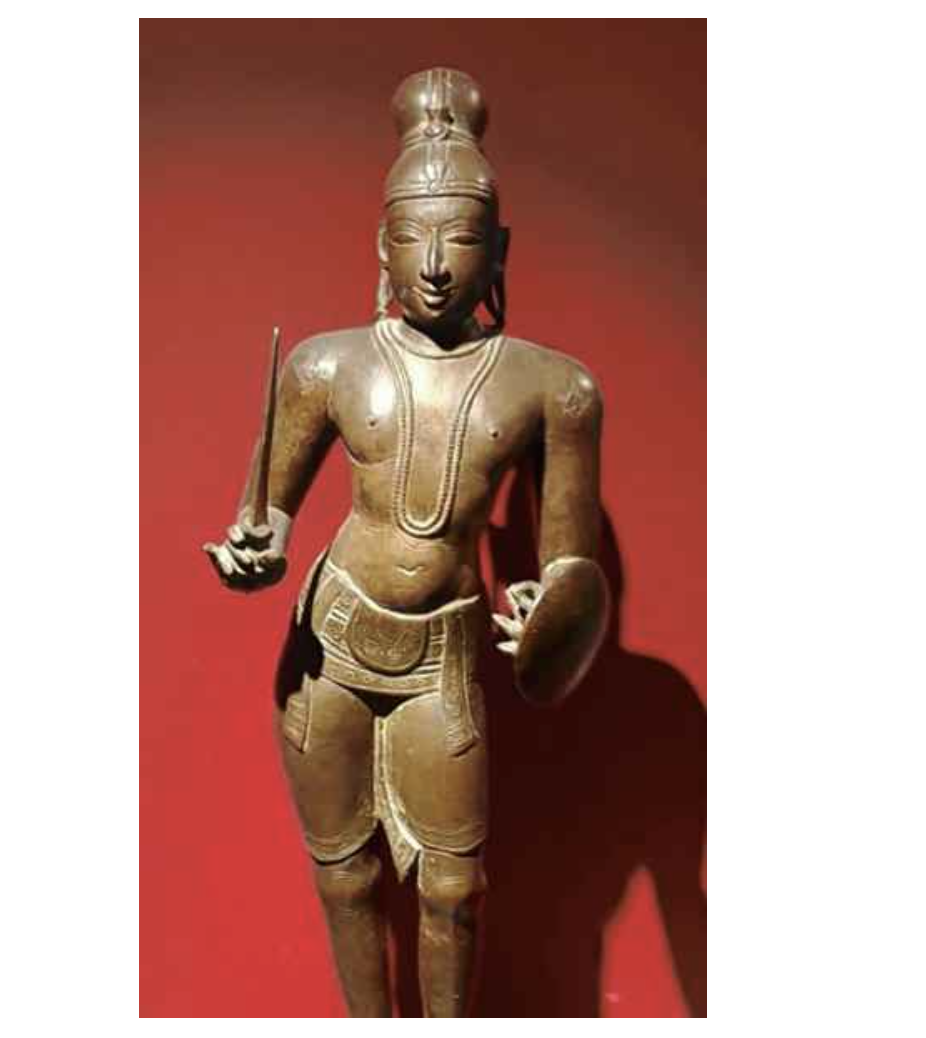
Thirumangai Alvar bronze statue
Context
The Ashmolean Museum, Oxford (United Kingdom) returned a 16th century bronze statue of Thirumangai Alvar to the Government of India.
The statue was handed over to the High Commission of India in London.
It originally belonged to the Sundararaja Perumal Temple, Thanjavur district, Tamil Nadu.
The idol will be restored to its original place of worship.
Thirumangai Alvar
Thirumangai Alvar is one of the 12 Alvars.
He holds the title Narkavi Perumal, the mark of an excellent poet,and Parakala (Beyond Time).
Though he is respected as a Vaishnava saint-poet, he was born as a Kshatriya and initially worked as a military commander under the cholas,a chieftain, and then a robber.
After his conversion to Vaishnavism, he confronted practitioners the sect of Shaivism, as well as Buddhism and Jainism.
The hagiographies detailing the life of Thirumangai and other Alvars are Divya charitam (11th century) and Guruparampara-prabhavam-arayirappadi (13th century) and Guruparampara-prabhavam-muvayirappadi (14th century).
Alvars were Tamil Vaishnavite poet-saints devoted to Lord Vishnu.
Their hymns are compiled in the Nalayira Divya Prabandham (4000 devotional verses).
They flourished roughly between the 6th–9th centuries CE.
They played a major role in the Bhakti movement in South India.
Cultural artefact repatriation
Meaning
Repatriation refers to the return of cultural artefacts to their country or original place of worship.
International framework
Governed mainly by the UNESCO 1970 Convention.
Objective:
Prevent illicit import and export of cultural property
Facilitate restitution of stolen antiquities.
Important prelims facts
12 Alvars – Vaishnavite Bhakti saints of Tamil Nadu.
Nalayira Divya Prabandham – 4000 Tamil hymns dedicated to Vishnu.
Ashmolean Museum – Oxford, established in 1683.
UNESCO 1970 Convention – prevents illicit trafficking of cultural property and promotes return of stolen artefacts.
Prelims practice MCQs
Q. Consider the following statements regarding the Alvars:
They were poet-saints devoted to Vishnu.
Their hymns are compiled in the Nalayira Divya Prabandham.
They flourished mainly in South India during the early medieval period.
Which of the statements given above are correct?
A. 1 only
B. 1 and 2 only
C. 1, 2 and 3
D. 2 and 3 only
Answer: C
Explanation:
The Alvars were Tamil Vaishnavite saints.
Their devotional hymns are compiled in the Nalayira Divya Prabandham (4000 verses).
They flourished roughly between the 6th and 9th centuries CE in South India.