
U.S. naval moves against Venezuela
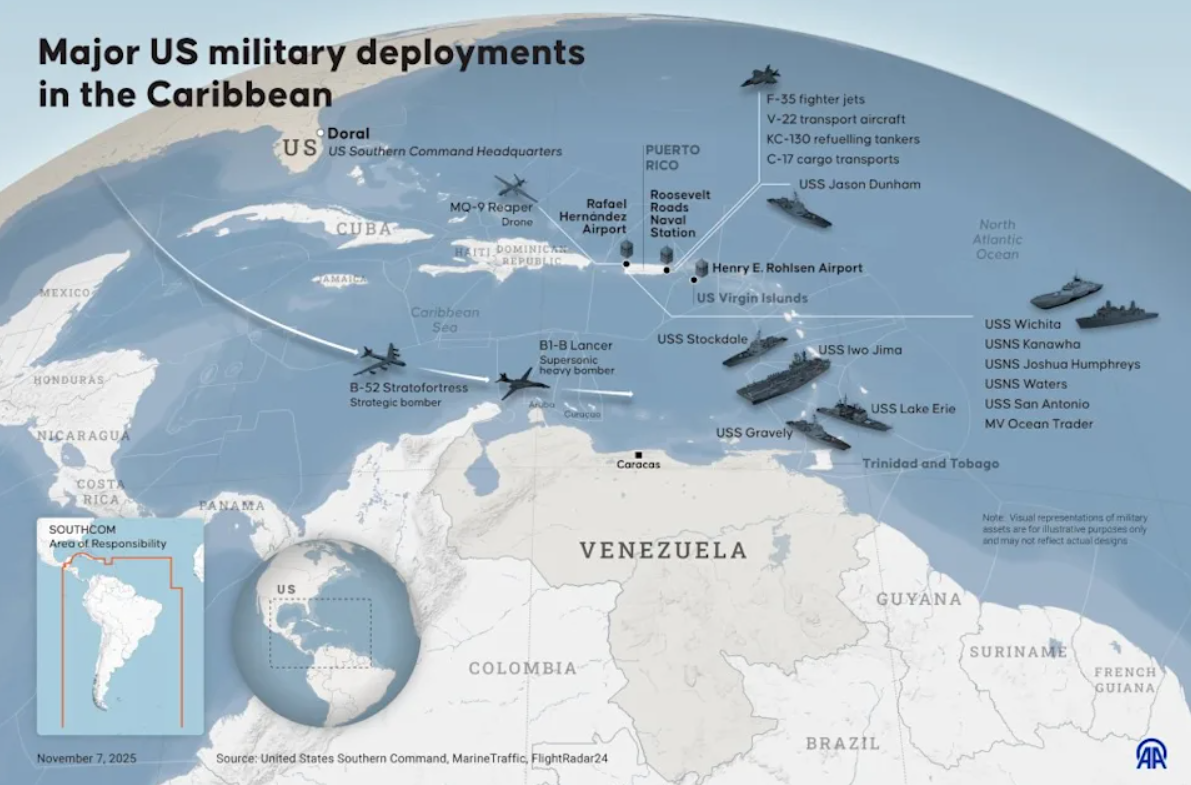
What happened?
The U.S. announced a “total and complete blockade of all sanctioned oil tankers” entering or leaving Venezuela.
This marks a rare instance of physical maritime enforcement, supplementing financial sanctions.

UNCLOS & boarding
Ships without valid flag registration:
Can be boarded under United Nations Convention on the Law of the Sea
Grounds include:
Statelessness
Piracy
Slave trade
False flagging
Shadow fleet
Ships that:
Avoid major insurers
Use obscure flags
Switch ownership frequently
Used by:
Russia
Iran
Venezuela
Challenge Western control of shipping and finance.
United Nations Convention on the Law of the Sea (UNCLOS)
What is UNCLOS?
UNCLOS is an international law that sets the rules for how countries can use the oceans.
It is often called the “Constitution of the Oceans” because it:
Defines who controls which part of the sea
Lays down rights and duties of countries
Regulates navigation, resources, environment, and disputes
Key facts
Adopted: 1982 (Montego Bay, Jamaica)
In force since: 1994
Parties: 160+ countries + European Union
Administered by: UN Division for Ocean Affairs and the Law of the Sea (DOALOS)
📌 India is a party to UNCLOS. (India signed UNCLOS in 1982 and officially ratified it on June 29, 1995, making it a State Party)
📌 USA is NOT a party, but follows many provisions in practice
Why was UNCLOS needed?
Earlier rules (1958–60 Geneva Conventions) were incomplete.
New issues emerged:
Offshore oil & gas
Deep-sea minerals
Fisheries disputes
Developing countries demanded fair sharing of ocean resources.
👉 UNCLOS was negotiated from 1973–1982 and replaced earlier conventions.
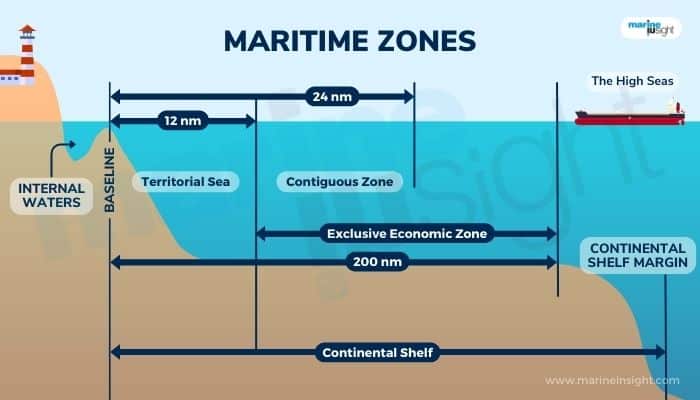
Maritime zones under UNCLOS
1. Territorial Sea
Up to 12 nautical miles
Coastal State has full sovereignty
Foreign ships enjoy innocent passage
2. Contiguous Zone
12–24 nautical miles
Coastal State can enforce laws related to:
Customs
Immigration
Sanitation
Fiscal matters
3. Exclusive Economic Zone (EEZ)
Up to 200 nautical miles
Coastal State has rights over:
Fisheries
Oil & gas
Marine resources
Other States enjoy:
Navigation
Overflight
4. Continental Shelf
Seabed beyond territorial sea up to:
200 nm (or more in some cases)
Rights over seabed resources only, not water column
5. High Seas
Beyond EEZ
Open to all States
Freedoms include:
Navigation
Fishing
Scientific research
“The Area” – Common Heritage of Mankind
The seabed beyond national jurisdiction
Mineral resources belong to all humanity
Managed by:
International Seabed Authority (ISA)
📌 No country can claim sovereignty over the Area.
Institutions created by UNCLOS
1. International Seabed Authority (ISA)
Regulates deep seabed mining
Ensures equitable benefit-sharing
2. International Tribunal for the Law of the Sea (ITLOS)
Settles disputes related to:
Maritime boundaries
Navigation
Detention of ships
📌 Located in Hamburg, Germany
Dispute resolution under UNCLOS
Countries can resolve disputes through:
ITLOS
International Court of Justice (ICJ)
Arbitration tribunals
📌 Focus on peaceful settlement, not force.
Enforcement & boarding
Under UNCLOS, warships may board foreign vessels on the high seas if there is reasonable suspicion of:
Statelessness
False flag
Piracy
Slave trade
Unauthorised broadcasting
👉 This is why ships without valid flags can be boarded legally.
UNCLOS has been supplemented by three key instruments:
1. 1994 Agreement (Part XI)
Modified deep seabed mining rules
2. 1995 UN Fish Stocks Agreement
For straddling & migratory fish stocks
3. 2023 BBNJ Agreement
Biodiversity in Areas Beyond National Jurisdiction
Focus:
Marine genetic resources
Environmental impact assessments
Marine protected areas
Boarding
👉boarding = legally getting on a ship for inspection or enforcement. Why boarding is done Boarding is carried out to:
Boarding under international law UNCLOS, 1982 A warship may board a foreign vessel on the high seas if there is reasonable suspicion that the ship is:
Boarding is a lawful enforcement action, not an act of war. | ||
Prelims Practice MCQ
Q. Assertion (A):
Ships without valid flag registration can be boarded by foreign navies.
Reason (R):
International law permits boarding of stateless or falsely flagged vessels.
Select the correct answer:
(a) Both A and R are true and R is the correct explanation of A
(b) Both A and R are true but R is not the correct explanation of A
(c) A is true but R is false
(d) A is false but R is true
Correct answer: (a)
Explanation
Assertion: True
Reason: True
UNCLOS explicitly allows boarding in such cases.
Q. Which of the following correctly describe “shadow fleets”?
Ships operating without major Western insurance cover
Vessels frequently changing ownership and flags
Ships officially certified by IACS members only
Select the correct answer using the code below:
(a) 1 and 2 only
(b) 2 and 3 only
(c) 1 only
(d) 1, 2 and 3
Correct answer: (a) 1 and 2 only
Explanation
Statement 3 is incorrect — shadow fleets often rely on non-IACS certification.