
UN Plastics Treaty
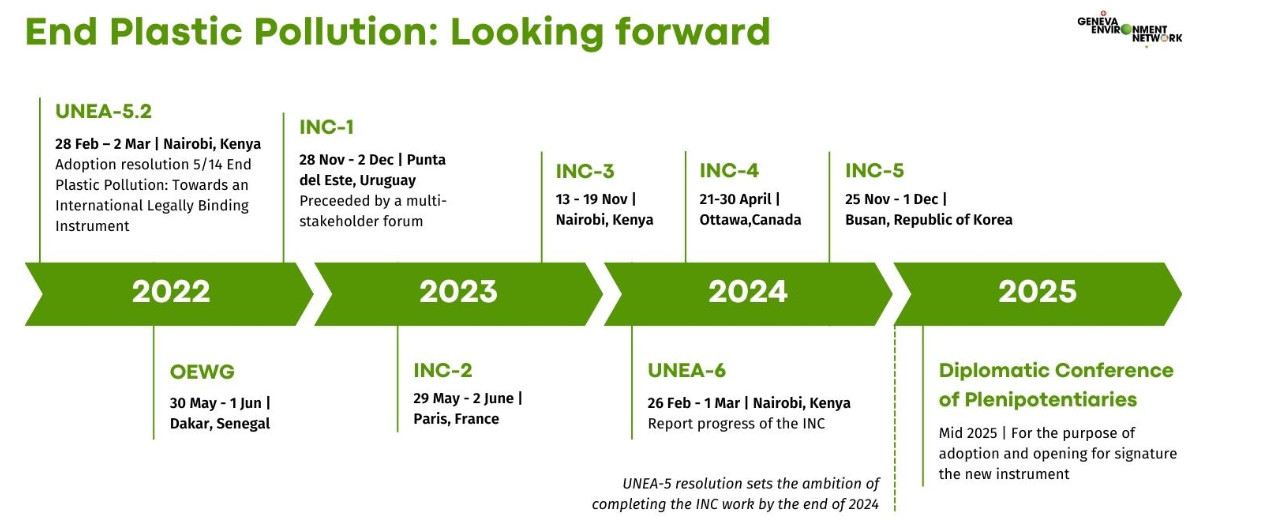
UN Plastics Treaty Mandate
-
At UNEA-5.2 (March 2022), 175 nations agreed to develop a legally binding treaty to end plastic pollution.
-
The treaty aims to address the “full life cycle of plastics” — from extraction to disposal.
-
An Intergovernmental Negotiating Committee (INC) was set up to draft the treaty by end of 2024.
-
The mandate had strong backing from civil society, scientists, and government representatives.
INC-1: Punta Del Este, Uruguay (December 2022)
-
Focus: Set procedures and scope of negotiations.
-
Divisions arose:
-
Oil-producing nations (e.g., US, Saudi Arabia) backed non-binding national action plans.
-
The High Ambition Coalition (Norway, Rwanda, others) demanded:
-
Production cuts
-
Phase-out of toxic additives
-
-
Africa, Costa Rica, Peru, Switzerland pushed for a global approach.
-
INC-2: Paris, France (May–June 2023)
-
Challenges:
-
Attendance caps limited civil society and Indigenous participation.
-
Procedural delays stalled negotiations.
-
-
Outcome:
-
Formation of two “contact groups”:
-
Group 1: Treaty objectives and obligations.
-
Group 2: Finance, capacity building, national implementation.
-
-
Agreement to develop a “zero draft” before INC-3.
-
INC-3: Nairobi, Kenya (November 2023)
-
Held near the Dandora dumpsite, symbolic of global plastic waste issues.
-
Progress:
-
Increased participation from Indigenous and third-sector groups.
-
Substantive discussions on the Zero Draft.
-
-
Challenges:
-
Strong industry presence and influence.
-
Disagreement on binding vs. voluntary commitments.
-
No agreement on intersessional work before INC-4.
-
INC-4: Ottawa, Canada (April 2024)
-
Focus: Effects of plastics on human and planetary health.
-
Developments:
-
Continued industry lobbying, calls for conflict-of-interest policies.
-
Indigenous groups again denied full participation.
-
Some nations pushed for:
-
Limits on plastic production
-
Elimination of toxic chemicals
-
-
-
Outcome:
-
Agreement on intersessional work, but excluded upstream measures (e.g., extraction, production limits).
-
Missed opportunity to address root causes of plastic pollution.
-
INC-5: Busan, Republic of Korea (Nov 2024)
-
Final planned session, but ended without agreement on production reduction.
-
Observations:
-
Continued industry obstruction and rightsholder exclusion.
-
Strong global support:
-
100+ countries backed Panama’s proposal to cut production.
-
95 supported binding chemical regulation targets.
-
120+ pushed for robust implementation mechanisms.
-
-
Record attendance: 3,300 delegates.
-
-
Outcome:
-
Gridlock on key issues; further negotiations needed.
-
Future Sessions
-
INC-5.2 planned in Geneva, Switzerland from August 5–14, 2025.
-
Aimed at resolving outstanding issues and finalizing the treaty.
Key Takeaways for UPSC
-
Treaty aims to be legally binding, global in scope, covering entire plastic life cycle.
-
Conflicting interests:
-
High Ambition Coalition vs. Petrostates and Plastic Industry.
-
-
Civil society, Indigenous groups face repeated exclusion.
-
The treaty is a test of multilateral environmental cooperation.
-
Industry influence remains a significant barrier.
-
The success of INC-5.2 is critical to deliver a meaningful treaty.