
Underwater Archaeological Survey off Poompuhar
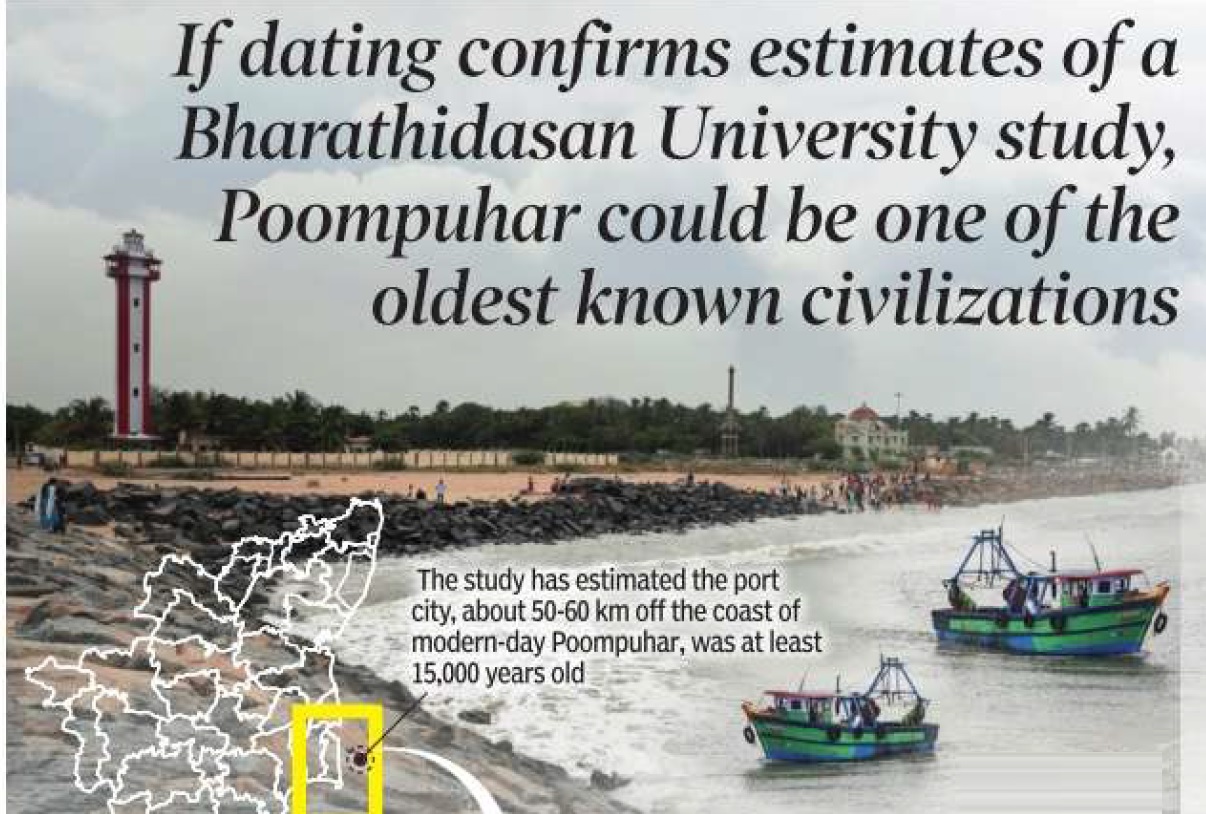
Background
Location: Poompuhar (ancient Kaveripoompattinam), a Sangam-era port city, located in Mayiladuthurai district, Tamil Nadu.
Historical Significance:
Once a flourishing maritime and trade centre mentioned in Tamil Sangam literature such as Silappatikaram and Manimekalai.
Believed to have been submerged under the sea due to coastal erosion or a major flood event (possibly around 500 CE).
Objective of the Survey
To identify potential archaeological remains of the ancient port city submerged in the Bay of Bengal.
To map and analyse underwater structural anomalies that may correspond to man-made artefacts or architectural remnants.
Findings and Analysis
Several underwater locations identified by veteran archaeologist S. R. Rao (in the 1990s) were retraced.
Collected data is currently being analysed to determine whether the identified formations are natural or man-made.
Next Step: A second phase of exploration is planned when sea conditions improve.
Related Past Efforts
Previous Survey (2022): Conducted at Korkai in Thoothukudi district (another ancient Tamil port).
Used NIOT’s coastal research vessel “Sagar Tara.”
Joint effort by TNSDA, NIOT, and Indian Maritime University divers.
Significance
Archaeological: Could provide insights into Sangam-era maritime trade, urban planning, and ancient Tamil civilisation.
Cultural Heritage: Strengthens Tamil Nadu’s claim as a centre of ancient maritime activity in the Indian Ocean region.
Scientific: Enhances India’s capacity for marine archaeology using advanced technology.
Tourism Potential: Discovery of submerged structures can promote heritage tourism in coastal Tamil Nadu.
POOMPUHAR (Kaveripoompattinam / Puhar)
Location and Overview
Present Location: Coastal town in Mayiladuthurai district, Tamil Nadu.
Ancient Names: Kaveripoompattinam, Kaveripattanam, Puhar.
Geographical Setting: Located near the mouth of the River Kaveri, along the Bay of Bengal coast.
Significance: One of the oldest maritime trade centres in South India, serving as a major port of the early Chola dynasty.
Mentions: Referred to in classical Greco-Roman sources like Periplus of the Erythraean Sea.
Historical Importance
Capital of Early Cholas: Temporarily served as the political and commercial capital of the early Cholas before the rise of Uraiyur and Thanjavur.
Trade Links: Had active maritime connections with:
Southeast Asia
Roman Empire
Greece and Arab traders
Economic Centre: A hub for import and export of spices, pearls, textiles, precious stones, and metals.
Archaeological Evidence
Marine Archaeology Findings:
Conducted by the National Institute of Marine Archaeology (Goa) and National Institute of Ocean Technology (NIOT).
Discovered submerged wharves, pier walls, and habitation sites off the coast.
Pottery dating back to the 4th century BCE found underwater.
Recent Survey (2025):
Conducted by the Tamil Nadu State Department of Archaeology (TNSDA).
Used ROVs, sonar mapping, sub-bottom profilers, and multibeam scanners to trace structural anomalies.
Findings: Indications of urban planning, wharf structures, and possible Buddhist monasteries near Pallavanesvaram.
Literary References
A. Sangam Literature (300 BCE–300 CE)
Texts: Pattinappaalai, Silappathikaram, Manimekalai, and Purananuru.
Depictions:
A city of wealth, beauty, and prosperity.
Descriptions of markets, warehouses, wide streets, temples, and mansions.
Flags flying in various parts of the city, denoting commercial and cultural vibrancy.
Example:
Purananuru (Poem 30) — describes ships entering the port without slackening sail and unloading valuable goods.
Pattinappaalai — praises the merchants’ ethics and trade prosperity under Karikala Chola.
B. Buddhist Literature
Buddhadatta (5th century CE) described Kaveripattinam as:
“Crowded with men and women of noble families, crystal-clear river waters, bazaars, gardens, and vihara built by Kanhadasa.”
Mentions of Buddhist monasteries and Buddhapada (footprint of Buddha) at Pallavanesvaram.
Manimekalai poem narrates the submergence of the city by the sea — a culturally remembered disaster.
Destruction of the City
Probable Cause:
Marine erosion and periodic tsunamis (as per marine geological evidence).
Manimekalai mentions that Puhar was swallowed by the sea.
Scientific Corroboration:
Marine archaeologists from National Institute of Oceanography (NIO) suggest sediment erosion and tectonic disturbances as causes.
Estimated Period: Around 300 BCE, large parts of the city were submerged.
Cultural and Ethical Aspects
Merchants of Puhar:
Practised ethical trade, avoided fraud, theft, and upheld justice (Pattinappaalai).
Example of moral and economic excellence in ancient Tamil society.
Religious Plurality:
Presence of Hindu temples, Buddhist monasteries, and possibly Jain shrines.