
Universe’s Antimatter Mystery
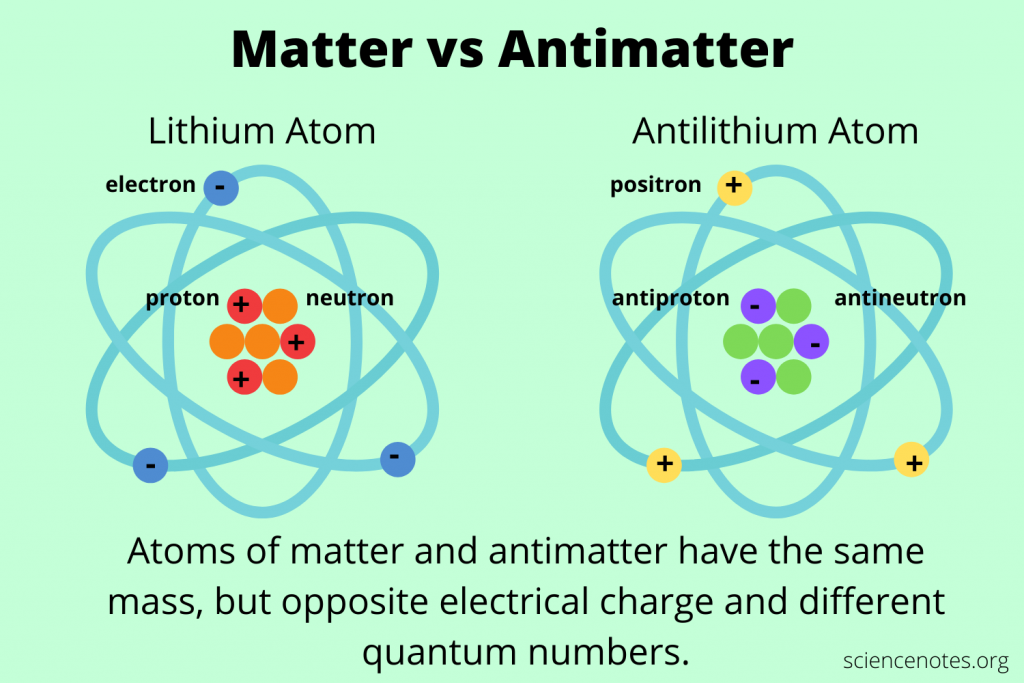
Context
Scientists at CERN (European Organization for Nuclear Research) have, for the first time, observed a difference in decay rates between a baryon and its antimatter counterpart, providing new evidence of CP violation — a key puzzle in understanding why the universe is dominated by matter and not antimatter.
The Matter-Antimatter Imbalance
-
According to the Big Bang theory, equal amounts of matter and antimatter should have been created.
-
Yet, the observable universe consists almost entirely of matter.
-
This imbalance suggests that subtle asymmetries must have existed, one of which is CP violation.
What is CP Violation?
-
CP = Charge Conjugation (C) + Parity (P)
→ Swapping a particle with its antiparticle and flipping its spatial orientation. -
CP violation means the laws of physics do not treat matter and antimatter identically under these transformations.
-
It is essential to explain why matter survived after the Big Bang.
New Discovery:
-
First CP violation observed in baryons (earlier only seen in mesons).
-
Studied particle: b⁰ baryon (contains up, down, and bottom quarks).
-
Observed decays into a proton, kaon⁻, and two pions.
-
Compared this with the decay of anti-b⁰ baryons.
Where and How:
-
Conducted at the Large Hadron Collider (LHC) using the LHCb detector.
-
Used data from billions of proton-proton collisions.
-
Machine learning algorithms identified rare decay events.
-
Measured CP asymmetry (difference in decay rates).
Result:
-
CP asymmetry measured: ~2.45%.
-
Statistical significance: 5.2σ (sigma) — meets the threshold to declare a scientific discovery.
-
Confirms that matter and antimatter decay differently, even in baryons.
Implications:
-
A major breakthrough in understanding the matter-antimatter asymmetry.
-
The amount of CP violation observed is still too small to fully explain the imbalance.
-
Encourages future studies on other baryons and theoretical advancements to discover new physics.
| Particle | Category | Made of | Charge | Mass (Relative) | Role / Significance | Examples / Notes |
|---|---|---|---|---|---|---|
| Baryon | Hadron | 3 Quarks | +1, 0, -1 | Heavy | Building blocks of matter (like protons, neutrons) | Proton (uud), Neutron (udd), Bottom Baryon (contains bottom quark) |
| Quark | Elementary Particle | Not made of anything smaller | Fractional charges (+2/3, -1/3) | Fundamental | Basic constituents of matter; combine to form hadrons | 6 types (flavours): up, down, charm, strange, top, bottom |
| Kaon (K) | Meson | 1 Quark + 1 Antiquark | +1, 0, -1 | Lighter than baryons | Involved in CP violation studies; decays quickly | K⁺ = up + anti-strange; Kaons show matter-antimatter differences |
| Pion (π) | Meson | 1 Quark + 1 Antiquark | +1, 0, -1 | Very light | Mediators of nuclear force between protons & neutrons | π⁺ = up + anti-down, π⁰ = mix of up-anti-up & down-anti-down |
Quick Explanation:
-
Hadrons = Particles made of quarks (includes Baryons and Mesons).
-
Baryons = 3 quarks (e.g., proton, neutron, b⁰ baryon).
-
Mesons = 1 quark + 1 antiquark (e.g., Kaons and Pions).
-
Quarks = Fundamental building blocks (cannot be broken further).
🧠 UPSC Relevance:
-
Science & Tech → Recent Developments
-
Prelims: Concepts of CP violation, LHC, antimatter, baryons.
-
Mains (GS Paper III): Application of modern physics in understanding universe origins.