
Vaccine‑Induced Immune Thrombocytopenia and Thrombosis.
Background
During the global rollout of COVID-19 vaccines in 2021, rare cases of unusual blood clots were reported.
These cases were mainly associated with adenoviral vector vaccines, particularly:
Oxford–AstraZeneca COVID‑19 vaccine
Johnson & Johnson COVID‑19 vaccine
The condition was termed Vaccine‑Induced Immune Thrombocytopenia and Thrombosis.
Incidence
Extremely rare: ~3–10 cases per million vaccinated individuals.
Characterised by:
Unusual blood clots (thrombosis)
Low platelet counts (thrombocytopenia)
What causes VITT?
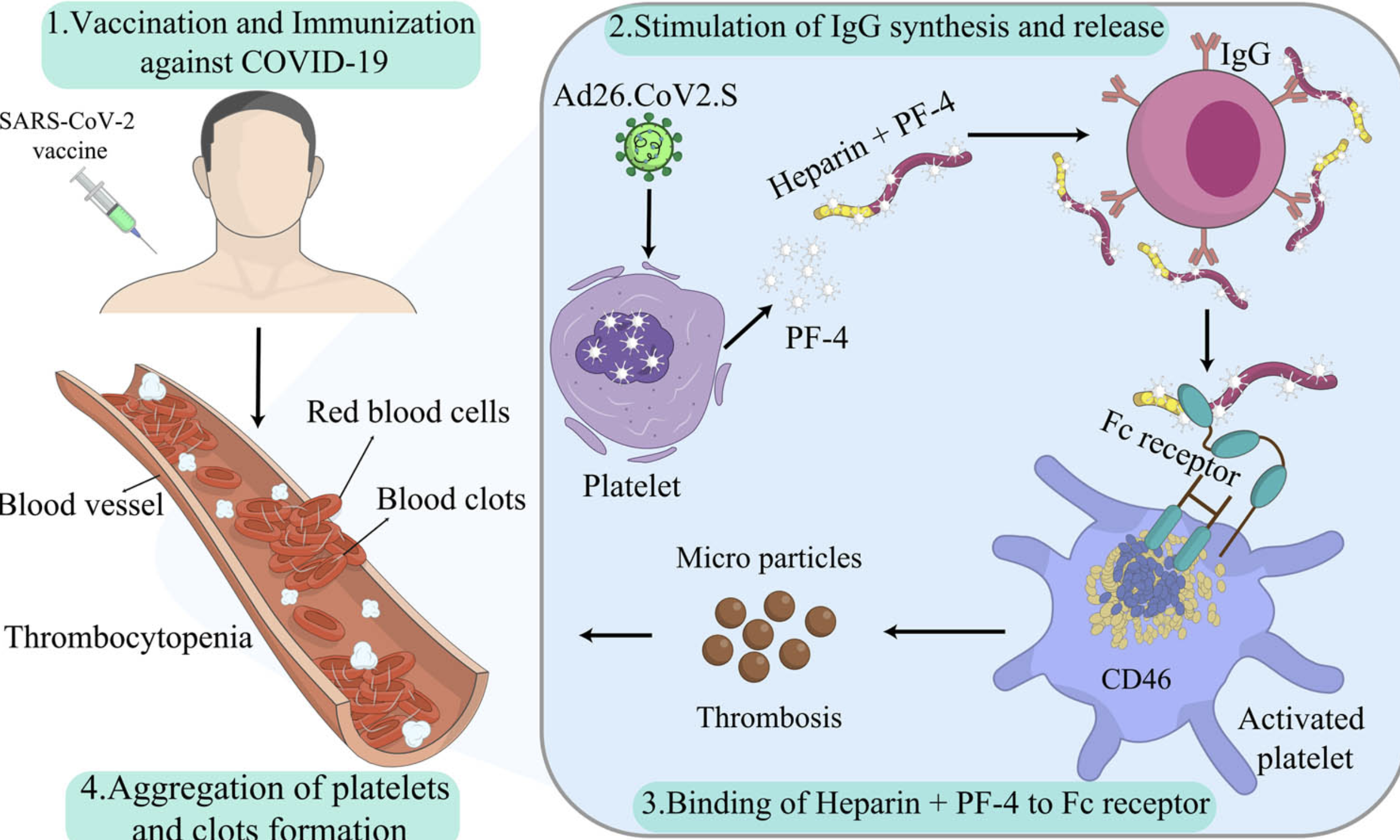
1. Role of platelet factor 4 (PF4)
A human protein called Platelet factor 4 normally helps regulate blood clotting.
In VITT patients:
The immune system produced antibodies against PF4.
These antibodies formed PF4–antibody complexes.
This activated platelets → causing clots while simultaneously reducing platelet numbers.
2. Why antibodies attacked a human protein
Normally, the immune system does not target self-proteins. The puzzle was why PF4 became a target.
Research published in The New England Journal of Medicine found that:
Antibodies from VITT patients were remarkably similar across different individuals worldwide.
They used the same antibody gene variants:
IGLV3-21*02
IGLV3-21*03
A single identical mutation occurred in these antibodies, changing the electrical charge of the binding site.
This mutation allowed antibodies to bind strongly to PF4, triggering platelet activation.
3. The adenovirus connection
Both AstraZeneca and J&J vaccines use adenovirus vectors to deliver DNA instructions for the coronavirus spike protein.
Scientists discovered that:
A component inside the adenovirus called protein VII has a segment resembling PF4.
When the immune system responded to the adenovirus:
It first produced antibodies against protein VII.
In rare individuals with specific antibody genes, the mutation caused these antibodies to mistakenly recognise PF4.
This molecular mimicry triggered the autoimmune reaction leading to VITT.
Why mRNA vaccines did not show this issue
Vaccines like:
Pfizer–BioNTech COVID‑19 vaccine
Moderna COVID‑19 vaccine
use mRNA technology:
mRNA directly enters the cell cytoplasm.
It does not use adenovirus vectors.
Therefore protein VII exposure does not occur, avoiding the PF4 mimicry pathway.
Scientific significance
The discovery identifies three key factors behind VITT:
Adenovirus protein VII acting as the trigger.
Specific antibody gene variants (IGLV3-21) in some individuals.
A single mutation altering antibody binding.
Prelims pointers
Adenoviral vector vaccines: deliver DNA via modified adenovirus.
mRNA vaccines: deliver messenger RNA directly into cytoplasm.
VITT: rare condition involving blood clots + low platelet counts.
PF4 antibodies are central to the pathology.
Mechanism involves molecular mimicry between viral protein VII and PF4.
Prelims Practice MCQ
Q. With reference to Vaccine-Induced Immune Thrombocytopenia and Thrombosis (VITT), consider the following statements:
It was primarily observed after vaccines using adenovirus vectors.
It involves antibodies targeting platelet factor 4 (PF4).
mRNA vaccines commonly cause VITT due to lipid nanoparticles.
Which of the statements given above is/are correct?
A. 1 only
B. 1 and 2 only
C. 2 and 3 only
D. 1, 2 and 3
Answer: B
Explanation:
VITT was mainly associated with adenovirus-vector vaccines, where antibodies target PF4, leading to platelet activation and clot formation. mRNA vaccines have not shown this mechanism, so statement 3 is incorrect.
Q. Match the following vaccines with their platform technology:
List I (Vaccine) | List II (Technology) |
A. AstraZeneca (ChAdOx1) | 1. Inactivated virus |
B. Covaxin | 2. Adenovirus vector |
C. Pfizer–BioNTech | 3. mRNA vaccine |
D. Sputnik V | 4. Viral vector (two adenovirus system) |
Codes
A. A-2, B-1, C-3, D-4
B. A-3, B-2, C-1, D-4
C. A-2, B-3, C-1, D-4
D. A-4, B-1, C-2, D-3
Answer: A
Explanation
AstraZeneca – adenovirus vector vaccine.
Covaxin – inactivated whole virus vaccine.
Pfizer–BioNTech – mRNA vaccine.
Sputnik V – two adenovirus vectors (Ad26 + Ad5).