
Vairamuthu wins the Jnanpith Award
Why in news
Renowned Tamil poet and lyricist Vairamuthu has been selected for the Jnanpith Award, the highest literary honour in India.
He becomes the third Tamil literary figure to receive the award, after a gap of 24 years.
Renowned Tamil poet and lyricist Vairamuthu has been selected for the Jnanpith Award, the highest literary honour in India.
He becomes the third Tamil literary figure to receive the award, after a gap of 24 years.
Previous Tamil recipients
Akilan – Jnanpith Award (1975)
Jayakanthan – Jnanpith Award (2002)
Vairamuthu – Latest recipient
Akilan – Jnanpith Award (1975)
Jayakanthan – Jnanpith Award (2002)
Vairamuthu – Latest recipient
About Vairamuthu
A leading Tamil poet, lyricist, and novelist.
Known for blending classical Tamil literary traditions with modern themes.
Received the Sahitya Akademi Award in 2003 for the novel Kallikattu Ithikasam.
Widely recognised for contributions to Tamil literature and film lyrics.
A leading Tamil poet, lyricist, and novelist.
Known for blending classical Tamil literary traditions with modern themes.
Received the Sahitya Akademi Award in 2003 for the novel Kallikattu Ithikasam.
Widely recognised for contributions to Tamil literature and film lyrics.
About the Jnanpith Award
Jnanpith Award is the oldest and highest literary award in India.
Instituted in 1961 and first awarded in 1965.
Presented annually by Bharatiya Jnanpith.
Given to an author for outstanding contribution to literature.
|
Eligibility
Awarded to Indian authors only.
Works must be written in languages listed in the Eighth Schedule of the Constitution of India and English.
Posthumous awards are not given.
|
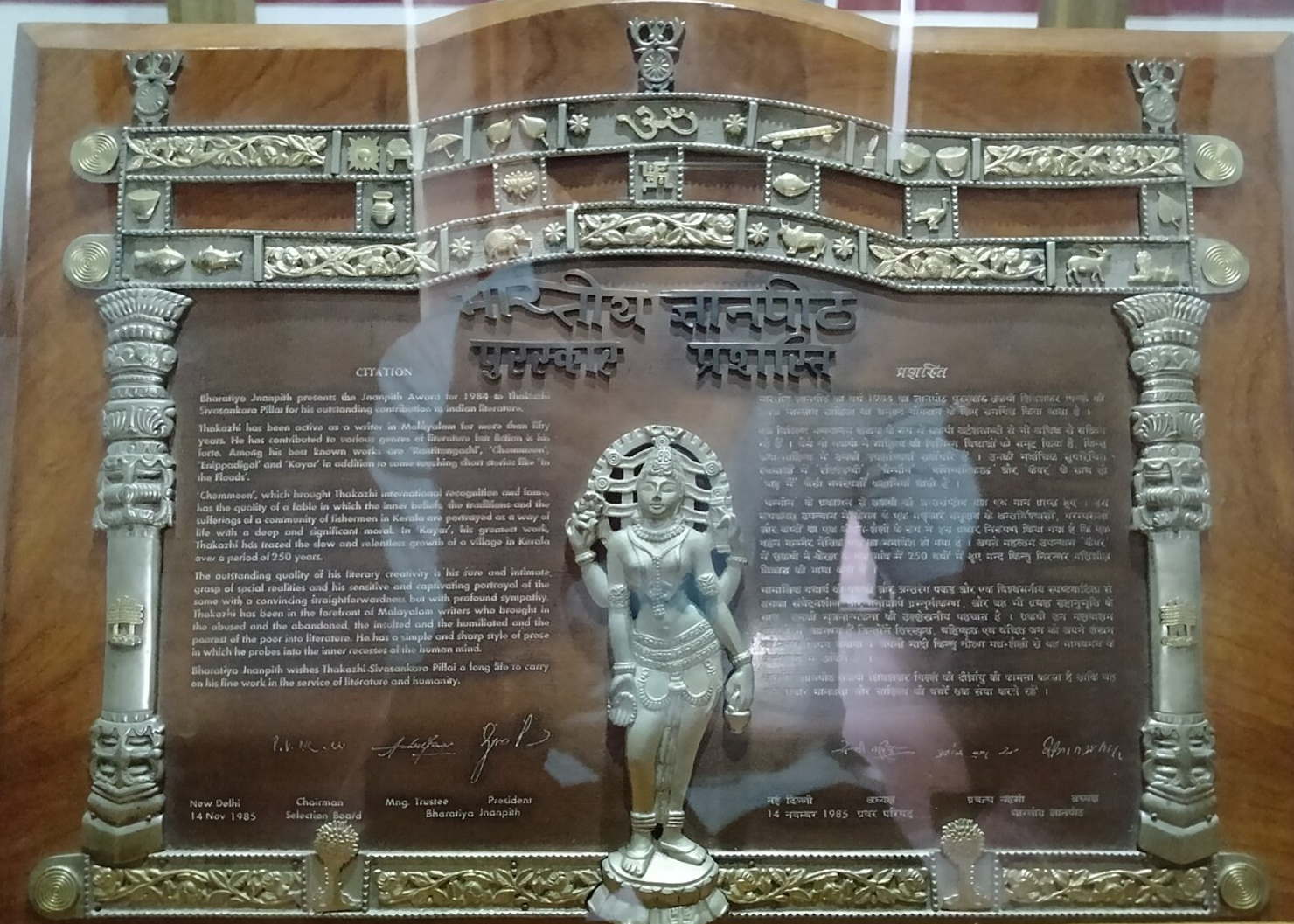
Components of the award
Cash prize: ₹11 lakh
Citation plaque
Bronze statue of Saraswati (Vagdevi)
|
First recipient
G. Sankara Kurup (Malayalam) – 1965
Awarded for the poetry collection Odakkuzhal (The Bamboo Flute).
|
Total awards
65 writers have received the award so far.
Includes 8 women recipients.
|
First woman recipient
Ashapoorna Devi (1976).
Honoured for the Bengali novel Prothom Protishruti.
|
Recent recipient
Vairamuthu – latest awardee.
|
Background
Bharatiya Jnanpith was founded in 1944 by industrialist Sahu Shanti Prasad Jain.
The idea of the award was proposed in 1961 to recognise the best literary work in Indian languages.
The initial proposal involved literary figures like:
Kaka Kalelkar
Harivansh Rai Bachchan
Ramdhari Singh Dinkar
The plan was presented to the then President Rajendra Prasad.
|
Selection process
Nominations received from:
Universities
Literary associations
Critics and scholars
Language advisory committees
Separate committee for each language.
Reconstituted every 3 years.
Selection board
Consists of 7–11 eminent members.
Evaluates works translated into Hindi or English.
Final decision
The Selection Board announces the winner.
|
Important rule
The language of the most recent winner is not considered for the next two years.
| ||
Prelims Pointers
Jnanpith Award – India’s highest literary award.
Established by Bharatiya Jnanpith (1961).
First awarded in 1965 to G. Sankara Kurup.
Awarded for literature in languages of the Eighth Schedule.
Jnanpith Award – India’s highest literary award.
Established by Bharatiya Jnanpith (1961).
First awarded in 1965 to G. Sankara Kurup.
Awarded for literature in languages of the Eighth Schedule.
Prelims Practice MCQs
Q. Consider the following statements regarding the Jnanpith Award:
It is the highest literary award in India.
It is given by the Sahitya Akademi.
It is awarded for literature written in languages listed in the Eighth Schedule of the Constitution.
Which of the statements given above is/are correct?
A. 1 and 3 only
B. 1 only
C. 2 and 3 only
D. 1, 2 and 3
Answer: A
Explanation:
Statement 1: Correct — Jnanpith is India’s highest literary award.
Statement 2: Incorrect — It is given by Bharatiya Jnanpith, not Sahitya Akademi.
Statement 3: Correct — It covers languages in the Eighth Schedule.
Q. Consider the following statements regarding the Jnanpith Award:
It is the highest literary award in India.
It is given by the Sahitya Akademi.
It is awarded for literature written in languages listed in the Eighth Schedule of the Constitution.
Which of the statements given above is/are correct?
A. 1 and 3 only
B. 1 only
C. 2 and 3 only
D. 1, 2 and 3
Answer: A
Explanation:
Statement 1: Correct — Jnanpith is India’s highest literary award.
Statement 2: Incorrect — It is given by Bharatiya Jnanpith, not Sahitya Akademi.
Statement 3: Correct — It covers languages in the Eighth Schedule.