
Weapons-grade uranium
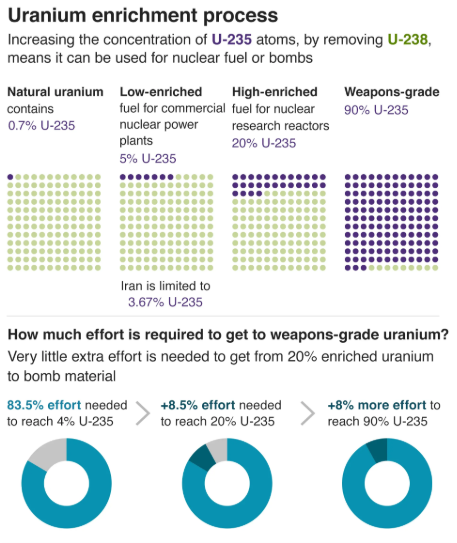
Weapons-grade uranium refers to uranium that has been enriched to a very high concentration of the fissile isotope uranium-235 (U-235), typically 90% or more. This level of enrichment is necessary to build an efficient and compact nuclear weapon.
Key Points:
-
Natural uranium contains about 0.7% U-235 (the rest is mostly U-238).
-
Low-enriched uranium (LEU) used in nuclear power reactors is enriched to 3–5% U-235.
-
Highly enriched uranium (HEU) is enriched above 20% U-235.
-
Weapons-grade uranium is enriched to ≥90% U-235, which enables:
-
A fast, uncontrolled chain reaction needed for a nuclear explosion.
-
A smaller, lighter, and more powerful warhead design.

Why is it dangerous?
Weapons-grade uranium allows a country to:
-
Build a nuclear bomb with much shorter preparation time (“breakout time”).
-
Evade international safeguards if diverted from peaceful uses.
-
Pose a major non-proliferation threat.
In the Iran context, their 60% enriched uranium stockpile is not yet weapons-grade, but it's very close—only a short enrichment step away. That’s why the global concern is so high.
HEU (Highly Enriched Uranium) – Uses & Characteristics
-
Definition: Uranium enriched to above 20% U-235 (60% enriched uranium stockpile in Iran case)
. Weapons-grade is typically 90%+.
-
Pilot enrichment & naval use:
-
Can be used in pilot enrichment cascades to develop or study nuclear reactors for naval propulsion (e.g., submarines).
-
Advantage: At 60% enrichment, the same amount of energy can be stored in a smaller volume, so fewer cylinders are needed for storage and transport.
-
-
Strategic military implication:
-
HEU is a short step away from weapons-grade, making it a sensitive material for non-proliferation.
-
LEU (Low Enriched Uranium) – Uses & Practicality
-
Definition: Uranium enriched to below 20%, commonly 3–5% for civilian reactors.
-
Main use: Fuel for nuclear power plants (like pressurized water reactors).
-
Down-blending HEU to LEU:
-
Technically possible to dilute HEU (like 60%) to get 19.75%, 5%, or 3% for various reactor uses.
-
But economically irrational because:
-
Requires prior energy-intensive enrichment just to dilute it later.
-
LEU can be more efficiently produced directly from natural uranium using conventional centrifuge methods.
-
-
Why Down-Blending HEU is Inefficient
-
It’s more practical and cheaper to:
-
Enrich natural uranium to LEU levels using centrifuges, or
-
Mix 20% uranium with natural/depleted uranium for lower grades.
-
-
Thus, HEU stockpiles are not preferred for civilian energy due to:
-
Cost,
-
Proliferation risk, and
-
Security/storage issues.
-