
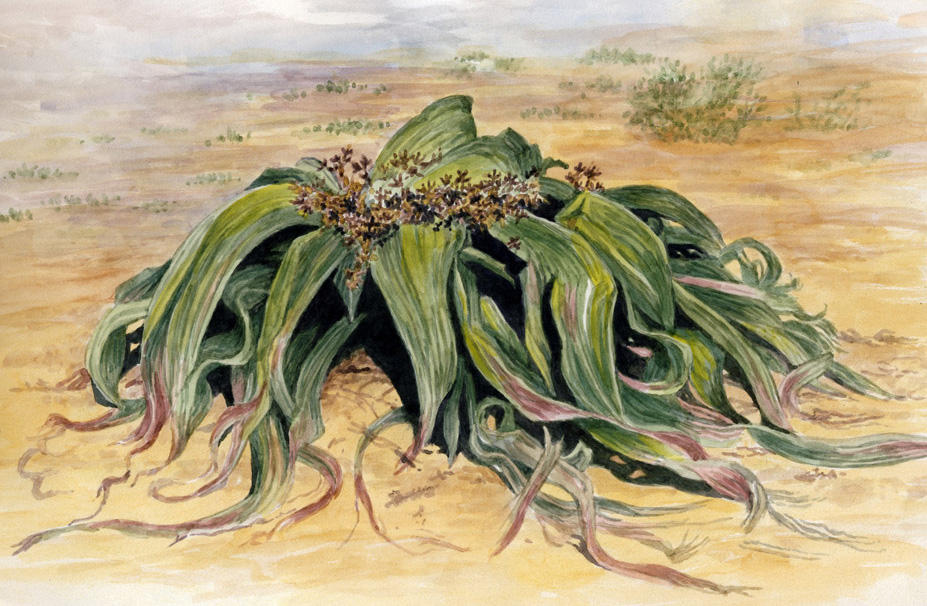
Welwitschia mirabilis
×
![]()
Why in news : PM Modi mentioned it during his visit to Namibia
Geographic Distribution:
- Endemic to the Namib
Desert in Namibia and southern Angola.
- Grows in extremely
arid and harsh desert
environments.
Unique Features:
- Often called a “living fossil”; it has existed for
over 100 million years.
- It produces only two permanent leaves in its
lifetime.
- These leaves grow continuously from the
base and can become tattered and split over time, giving the
appearance of multiple leaves.
- The plant may live for 1,000 to 2,000
years.
- Has a thick, woody stem and deep taproot
system to absorb underground moisture.
Physiological Adaptations:
- CAM Photosynthesis: Conserves water by fixing CO₂ at night.
- Can absorb fog moisture using
its leaf surface.
- Highly adapted to extreme drought,
high temperature, and nutrient-poor soils.
Reproduction:
- Dioecious plant: meaning pollen cones and seed cones are produced on
separate plants Male and female cones grow on separate plants.
- Pollination occurs via insects,
especially flies and true bugs.
Conservation Status:
- Listed as Near Threatened (NT) on the IUCN Red
List.
- Threats include:
- Climate change
- Habitat disturbance
- Illegal collection by plant enthusiasts
Evolutionary Significance:
- Belongs to the Gnetophytes, a
group of gymnosperms distinct from conifers and cycads.
- Shares some angiosperm-like features
(such as vessel elements), making it important in understanding plant
evolution.
Cultural and Scientific Importance:
- Considered Namibia’s national plant.
- Its survival strategy and anatomy are
widely studied in botany, paleobotany, and ecology.
- Sometimes referred to as the “most bizarre plant on Earth”.