
Western Tragopan (Tragopan melanocephalus)
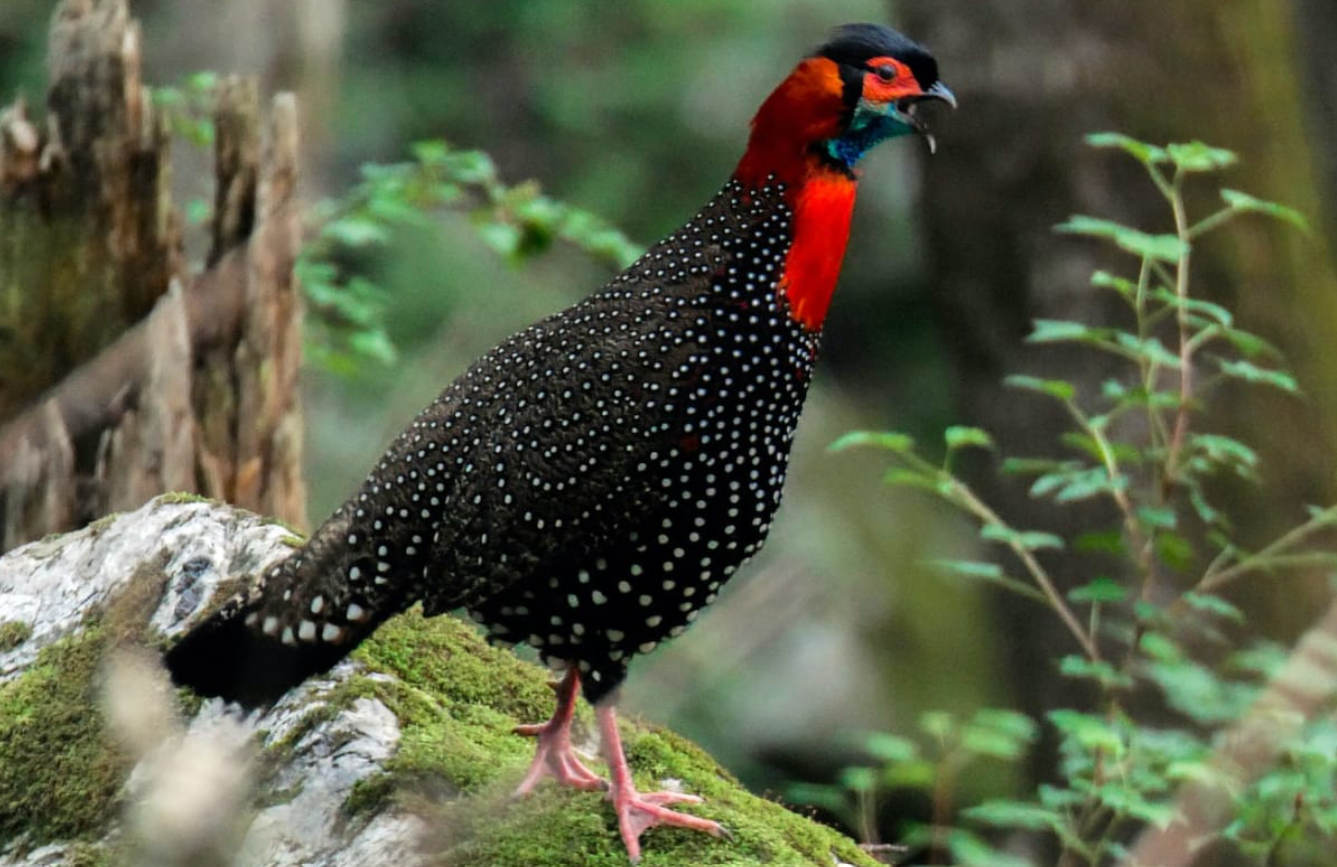
Conservation Status & Distribution
• IUCN Status: Vulnerable (VU)
• Population Trend: Decreasing
• Estimated Population: 3,000–9,500 mature individuals, belonging to one single subpopulation
• Past Range: Jammu & Kashmir, Himachal Pradesh, Uttarakhand
• Current Range: Small fragmented pockets in the western Himalayas, including parts of Pakistan

Legal Protection (India)
• Protected under: Schedule I, Wildlife Protection Act, 1972
• State Bird of Himachal Pradesh
Key Threats
• Habitat loss & fragmentation (development, grazing, forest produce collection)
• Climate change: warming at lower altitudes, mismatch between breeding timing and insect availability
• Anthropogenic disturbances: tourism pressure in some zones, human movement
• Hunting pressure (historical + local)
→ Leads to low reproductive success & population instability.
Captive Breeding — Sarahan Pheasantry
Origin & Milestones
• First captive births: 1993 (WII records)
• 2005: World’s first successful captive breeding of Western Tragopan — four chicks hatched at Sarahan Pheasantry
• 2007–2015: 43 captive-born birds, but fluctuating survival due to:
– Skewed sex ratios
– Mortality among older birds
• Genetic bottleneck: All captive birds originate from eight wild founders, yet retain 87% genetic diversity
Stabilisation Efforts
• Development of species-specific husbandry protocols, based on wild behaviour
• Recreating natural habitat inside enclosures:
– Dense cover
– Natural nesting materials
– Seasonal diet matching wild conditions
• Result: Stable captive population (~46 birds); 6–8 eggs hatch yearly, 4–5 chicks survive.
Climate Variability Impacts
• Mismatch between breeding season and peak insect availability → chick starvation risk
• Warming at lower altitudes may push birds upslope
• Climate-linked changes threaten:
– Foraging behaviour
– Predator–prey balance
– Vegetation patterns
Reintroduction Attempts
• Experimental reintroductions (2020–21):
– Birds fitted with radio collars
– One bird survived nearly a year in the wild → positive early sign
• Reintroduction stalled since 2023 due to:
– Budget constraints
– Need for rigorous, long-term research protocols
• Key prerequisites for release:
– Predator monitoring
– Food availability checks
– Behavioural adaptation of captive birds
• Rewilding = long-term commitment; cannot happen abruptly
Community-Based Conservation
• Local stewardship & tourism emerging as strong supportive tools
• In regions like Rakhundi and Shilt, villagers protecting breeding sites led to increased sightings
• Reduces dependence on forest extraction → win–win for biodiversity & livelihoods
Tragopans:
Overview
• A distinctive group of pheasants found in India, Nepal, Pakistan, Bhutan and China in montane Himalayan forests.
• The name comes from Greek: tragus (goat) + pan (goat-like Greek god).
• Also called horned pheasants because males have two fleshy, erect horns on their heads.
• Known for vibrant plumage, white spotting, and inflatable colourful facial skin used in courtship displays.
Characteristics and Behaviour
• Extremely elusive and difficult to sight; prefer dense undergrowth.
• When disturbed, they escape into trees, not across ground.
• Males make deep, repeated wailing calls during the breeding season.
• Unlike most pheasants, tragopans nest in trees — using cavities or old nests of other birds.
• Diet: forage on ground and in trees using their short, stout bills.
Species of Tragopans (5 globally; 4 in India)
1. Western tragopan — Tragopan melanocephalus
• Found in western Himalayas (India + Pakistan).
• One of the rarest pheasants in the world.
• State bird of Himachal Pradesh → high UPSC relevance.
2. Satyr tragopan — Tragopan satyra
• Central Himalayan species.
3. Temminck’s tragopan — Tragopan temminckii
• Eastern Himalayas and NE India.
4. Blyth’s tragopan — Tragopan blythii
• Found in Northeast India and neighbouring regions.
• Two subspecies:
– T. b. molesworthi
– T. b. blythii
5. Cabot’s tragopan — Tragopan caboti
• Found only in China.
• Two subspecies: T. c. caboti, T. c. guangxiensis

Prelims Practice MCQs
Q. Consider the following statements regarding the Western Tragopan:
It is endemic to India and found only in Himachal Pradesh.
It is listed under Schedule I of the Wildlife Protection Act, 1972.
All surviving mature Western Tragopans belong to a single global subpopulation.
How many of the above statements are correct?
a) Only one
b) Only two
c) All three
d) None
Correct Answer: b) Only two
Explanation:
• Statement 1 – Incorrect: It is not endemic to India. It is found in India and Pakistan.
• Statement 2 – Correct: The species is protected under Schedule I, WPA 1972.
• Statement 3 – Correct: IUCN assesses the entire remaining population as a single subpopulation, increasing vulnerability.
Q. Consider the following statements about the habitat of Western Tragopan:
The species prefers dense montane forests of the Western Himalayas.
It nests only on the ground, like most pheasants.
Human disturbance, even in climatically suitable zones, continues to threaten its survival.
How many of the above statements are correct?
a) Only one
b) Only two
c) All three
d) None
Correct Answer: b) Only two
Explanation:
• Statement 1 – Correct: It occupies dense temperate forests in the Western Himalayas.
• Statement 2 – Incorrect: Unlike most pheasants, Tragopans nest on trees (cavities or old nests).
• Statement 3 – Correct: Studies from Kazinag & Limber show that suitable habitat exists but disturbance fragments populations.
Q. Which of the following statements correctly describe the Western Tragopan's biological traits?
Males possess bright colouration and inflatable facial ornaments used in courtship.
It is one of the few pheasants that regularly use tree nests.
Females are brightly coloured to attract males.
Select the correct answer:
a) 1 and 2 only
b) 2 and 3 only
c) 1 and 3 only
d) 1, 2 and 3
Correct Answer: a) 1 and 2 only
Explanation:
• Statement 1 – Correct: Bright plumage + inflatable throat skin + “horns” used during display.
• Statement 2 – Correct: Tree nesting is a distinctive Tragopan trait.
• Statement 3 – Incorrect: Females are dull-coloured, aiding camouflage.