
Why the Thwaites Glacier matters
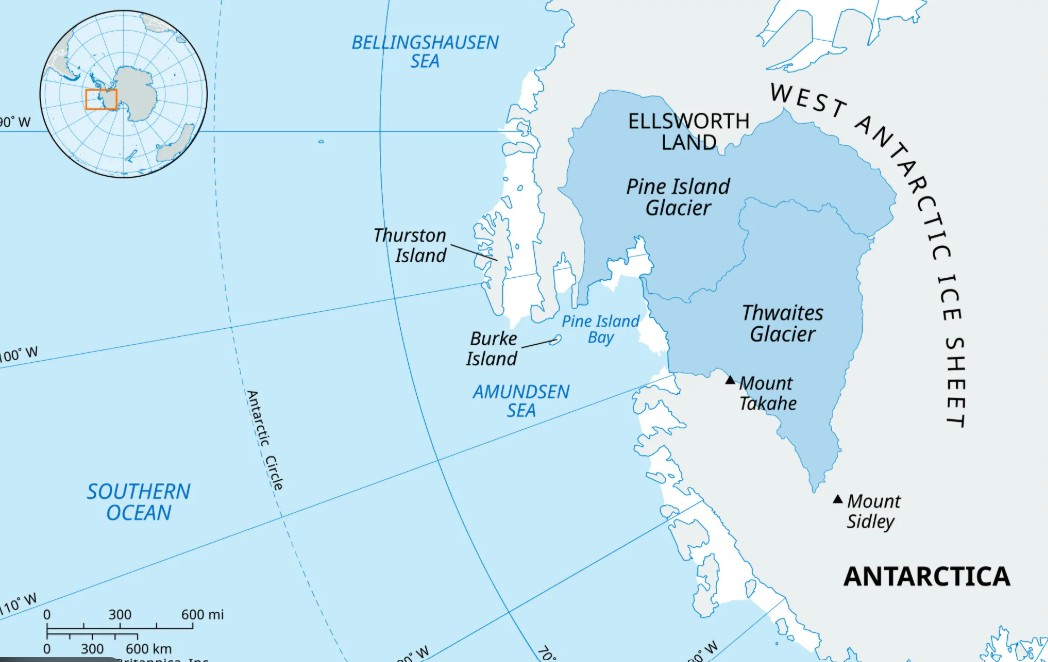
What is Thwaites Glacier?
Thwaites Glacier is a massive glacier in West Antarctica, roughly the size of a large country. It has earned the media nickname “Doomsday Glacier” because of its potential to drive significant global sea-level rise.

Why Thwaites is scientifically critical
1. Its unique geography
The glacier rests on bedrock that slopes downward inland (retrograde slope).
This makes it inherently unstable once melting begins.
Warm ocean water can flow underneath the glacier’s floating ice shelf, melting it from below.
2. Role of the ice shelf (the “doorstop effect”)
The ice shelf acts like a brace or doorstop, slowing the glacier’s movement into the ocean.
As the ice shelf:
Thins
Fractures
Or partially collapses
The glacier accelerates, discharging more ice into the sea.
3. Evidence of ongoing change
Scientific observations show that Thwaites is:
Thinning
Retreating inland
Already contributing to sea-level rise
This indicates the process is not hypothetical, but already underway.
Global consequences of collapse
Direct impact
A complete long-term collapse of Thwaites alone could raise global sea levels by ~0.5 metres.
Cascading effects
Thwaites acts as a buttress for nearby glaciers in the West Antarctic Ice Sheet (WAIS).
If it weakens beyond a tipping point:
Adjacent glaciers may also accelerate
Sea-level rise could increase well beyond half a metre
Why this matters for humanity
Even though Thwaites is geographically remote:
Rising sea levels will:
Flood coastal regions more frequently
Intensify storm surges
Accelerate coastal erosion
Threatened areas include:
Coastal cities
Low-lying islands
Ports and economic hubs
Why Thwaites is a climate tipping element
Sensitive to ocean warming, not just air temperature
Exhibits potential irreversibility once retreat crosses a threshold
Central to projections of future sea-level rise
Prelims practice MCQs
Q. Thwaites Glacier is often described as particularly vulnerable because:
A. It lies entirely below sea level
B. It rests on land sloping downward inland
C. It is the largest glacier in Antarctica
D. It is located near the South Pole
Correct answer: B
Explanation: The retrograde bed slope allows warm ocean water to destabilise the glacier from below, increasing retreat.
Q. The ice shelf associated with Thwaites Glacier is important because it:
A. Produces freshwater for oceans
B. Prevents snowfall accumulation
C. Acts as a brace slowing glacier flow
D. Reflects maximum solar radiation
Correct answer: C
Explanation: The ice shelf functions like a doorstop, restraining ice flow into the ocean.