
World Bank to fund T.N. village councils for mangrove plantation
Context :
The World Bank and Tamil Nadu government have launched a ₹1,675-crore project called TN-SHORE.
Goal: protect the coast, restore marine life, and help local communities.
Mangroves
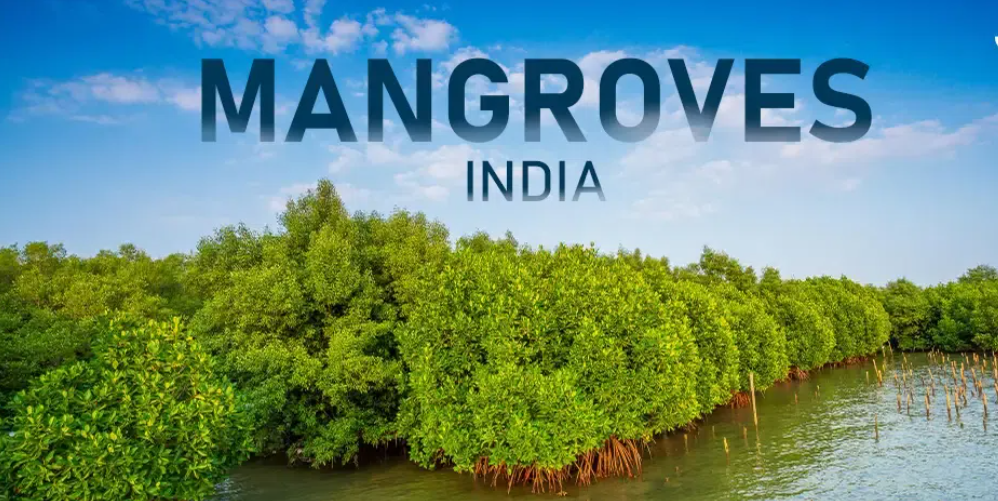
Mangroves are special coastal trees that protect the shore from cyclones, floods, and erosion.
Under TN-SHORE, 1,000 hectares of mangroves will be restored:
300 hectares = new plantations
700 hectares = degraded mangroves revived
How it will work
Instead of money going through many layers, the World Bank will directly give funds to village mangrove councils.
Composed of local residents
President: Community member
Member-secretary: Forest Range Officer
Each village can use up to ₹8 lakh for plantation without big tenders.
Already, ₹38 crore has been set aside for this.
Why this matters
Tamil Nadu currently has 41.9 sq. km of mangroves, but many are damaged.
Restoring them will:
Strengthen coastal protection
Provide habitats for turtles, dugongs, and fish
Support eco-tourism and livelihoods
Reduce plastic waste and erosion
Mangroves
Mangroves are special trees and shrubs that grow in salty or brackish water along seashores, estuaries, and tidal areas of tropical and subtropical regions.
Where they grow: They are found in muddy coasts, river mouths, lagoons, and tidal creeks — places where land meets the sea.
Height: They usually grow between 8 to 20 metres tall.
Salt Tolerance:
Mangroves are halophytes (salt-loving plants).
They block salt at their roots or push it out through glands in their leaves.
Unique Roots:
Prop/Stilt roots (e.g., Rhizophora) grow above ground to support the tree.
Pneumatophores (air roots, e.g., Avicennia) grow upward from the mud to breathe in oxygen.
Adaptation:
Survive in salty water, high tides, and oxygen-poor soil.
Leaves are thick to reduce water loss.
Importance of Mangroves
Coastal Protection: Act as a natural barrier against cyclones, storms, and tsunamis.
Fisheries Support: Serve as a breeding ground for many fish and marine species.
Productivity: They are one of the most productive ecosystems on earth.
Ecotone: Represent a transitional zone between land and sea ecosystems.
Mangroves in India – ISFR 2023
Key Statistics
Total Cover: 4,991.68 sq. km (0.15% of India’s geographical area).
Growth Trend:
↑ 363.68 sq. km since 2013 (+7.86%).
↑ 509.68 sq. km since 2001 (+11.4%).
State-wise Mangrove Cover
West Bengal – Largest share (Sundarbans).
Gujarat – Extensive tidal areas.
Andaman & Nicobar Islands – Island ecosystems.
👉 Increase seen in most states/UTs except Gujarat and Andaman & Nicobar Islands.

Government Initiatives
MISHTI (Mangrove Initiative for Shoreline Habitats & Tangible Incomes) – Promotes mangrove plantation and restoration.
National Coastal Mission – Provides financial aid to coastal states/UTs for conservation.
Coastal Regulation Zone (CRZ) 2019 – Declares mangroves as Ecologically Sensitive Areas; regulates activities in these zones.
Conservation of Mangroves
Assigning Mangroves UNESCO Designated Sites
The inclusion of mangroves in the field of biosphere reserves, World Heritage Sites, and also UNESCO Global Geoparks helps to improve the management and also conservation of the mangroves.
International Day for Conservation of the Mangrove Ecosystem
It is celebrated on July 26 with the aim of increasing awareness of the mangrove ecosystems and also to promote sustainability.
Blue Carbon Initiative
It focuses on the conservation and also restoring of coastal and marine ecosystems. The initiative is coordinated with Conservation International (CI), IUCN, and Intergovernmental Oceanographic Commission-UNESCO.
National Mangrove Committee
The government of India set up a National Mangrove Committee in 1976 for the conservation and development of mangroves.