
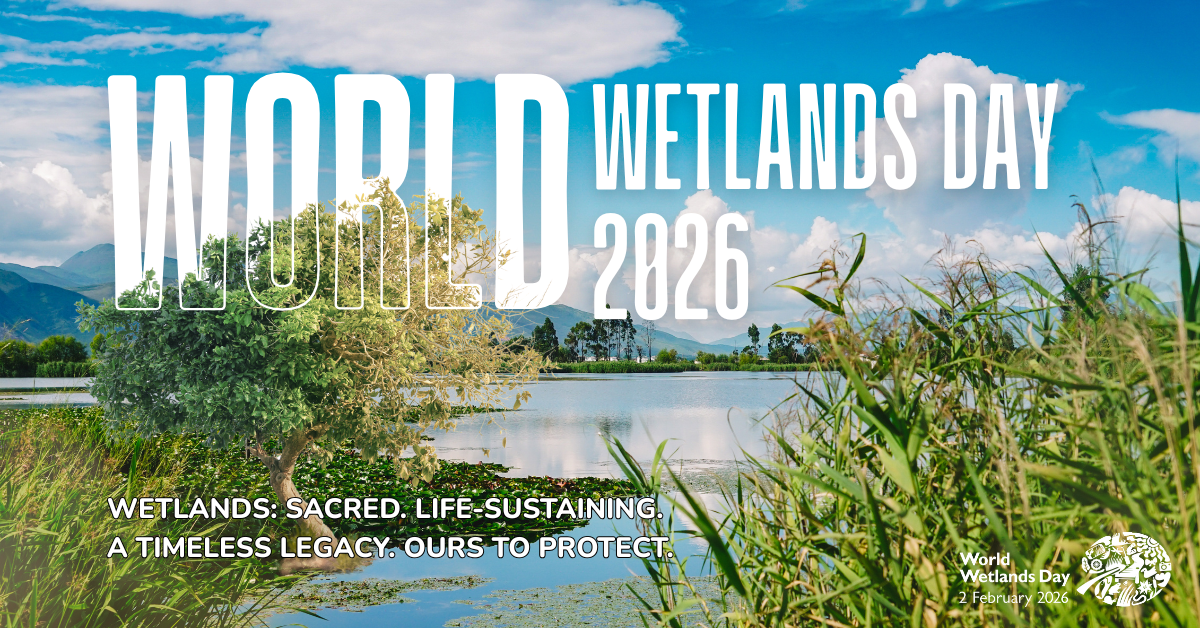
World Wetlands Day 2026
Context
World Wetlands Day 2026 (February 2)
Theme: “Wetlands and traditional knowledge: Celebrating cultural heritage”
Indian context is significant due to centuries-old community-managed wetland systems.
Importance of wetlands in India
Ecological functions
Flood buffering and groundwater recharge
Water purification and nutrient cycling
Biodiversity habitats (fish, birds, mangroves, wetland flora)
Socio-economic and cultural roles
Livelihoods: agriculture, fishing, livestock, salt pans
Cultural heritage: rituals, festivals, traditional water governance
Act as ecology + economy, habitat + heritage
Traditional knowledge and community practices
Examples across India
Tamil Nadu:
Human-made tanks (kulams)
Cascading irrigation networks for paddy cultivation
Kerala (Wayanad):
Shallow wells (kenis) over 200 years old
Used for drinking water, rituals and festivals
Andhra Pradesh (Srikakulam):
Wetlands sustaining traditional fishing systems
Significance
Traditional practices inherently:
Regulated water use
Maintained hydrological balance
Protected ecosystems through collective norms

Status of wetlands in India
Nearly 40% of India’s wetlands lost in the last three decades
About 50% of remaining wetlands degraded
Among the most threatened ecosystems due to overlap with:
Land
Water
Development pressures
Policy and regulatory framework
Existing instruments
Wetlands (Conservation and Management) Rules, 2017
Identification, notification and regulation of activities
National Plan for Conservation of Aquatic Ecosystems (NPCA)
Structured planning, monitoring, outcome-based management
Coastal Regulation Zone (CRZ) framework
Protection of coastal wetlands
Ramsar Convention
India has 98 Ramsar sites
Represents global responsibility, not symbolic recognition
Key issue
Problem is not lack of laws, but weak implementation
Poor coordination across freshwater, coastal, urban, riparian and high-altitude wetlands
Major challenges to wetland conservation
1. Land-use change and encroachment
Urbanisation, infrastructure, real estate, roads
Around 40% natural wetlands erased
Old cadastral maps do not match ground realities
2. Hydrological disruptions
Dams, embankments, channelisation
Sand mining and groundwater over-extraction
Loss of natural flow timing and connectivity
3. Pollution and eutrophication
Untreated sewage
Industrial effluents
Agricultural runoff and solid waste
Leads to:
Biodiversity collapse
Loss of flood-buffering capacity
Reduced water purification
4. Urban wetland stress
Expected to:
Store floodwater
Receive sewage
Remain clean and biodiverse
Often lack legal buffers and protection
5. Coastal and climate-related pressures
Sea-level rise, cyclones, shoreline erosion
Mangroves and lagoons trapped between:
Development pressure (landward)
Rising seas (seaward)
6. Institutional and capacity constraints
State wetland authorities:
Understaffed
Underfunded
Skill gaps in:
Hydrology
Ecology
GIS and remote sensing
Environmental law
Community engagement
Need for a paradigm shift
From projects → programmes
From beautification → ecological functionality
From departmental silos → watershed-scale governance
Key recommendations and way forward
1. Notification and boundary protection
Effective notification under 2017 Rules
Publicly accessible maps
Grievance redress mechanisms
Participatory ground-truthing with communities
2. Treat wastewater before it reaches wetlands
Wetlands cannot replace sewage treatment plants
Constructed wetlands may complement, not substitute, treatment
3. Catchment-based management
Restore feeder channels
Prevent blockages by roads and embankments
Regulate extraction affecting hydrology
4. Wetlands as disaster risk reduction infrastructure
Mangroves, floodplains, mudflats as nature-based solutions
Integrate wetlands into climate adaptation planning
CRZ enforcement with livelihood-sensitive approaches
5. Capacity and institution building
National capacity mission for wetland managers
Training in:
Hydrology
Restoration ecology
GIS and remote sensing
Environmental law
Community-led governance
NPCA funding linked with:
Performance indicators
Livelihood outcomes
Role of technology and science
Satellite remote sensing, drones, time-series analytics
Monitoring:
Encroachment
Inundation
Vegetation change
Science-based, outcome-oriented management plans
Prelims Practice MCQs
Q. World Wetlands Day 2026 was observed with which of the following themes?
(a) Wetlands and climate resilience
(b) Wetlands and biodiversity conservation
(c) Wetlands and traditional knowledge: Celebrating cultural heritage
(d) Protecting wetlands for future generations
Correct answer: (c)
Explanation:
World Wetlands Day 2026 focused on traditional knowledge and cultural heritage, highlighting community-led wetland stewardship.
Q. With reference to wetlands in India, consider the following statements:
Nearly 40% of India’s wetlands have disappeared over the last three decades.
About half of the remaining wetlands show signs of ecological degradation.
Wetlands are least affected by development pressures due to legal protection.
Which of the statements given above are correct?
(a) 1 and 2 only
(b) 2 and 3 only
(c) 1 only
(d) 1, 2 and 3
Correct answer: (a)
Explanation:
Statements 1 and 2 are explicitly mentioned in the article.
Statement 3 is incorrect: wetlands are among the most threatened ecosystems, lying at the intersection of land, water and development.